Toca Boca World
Educational4.4 out of 5

For Android & iOS · IHUMAN (SG) PTE. LTD.

 Analysis by Gamesive
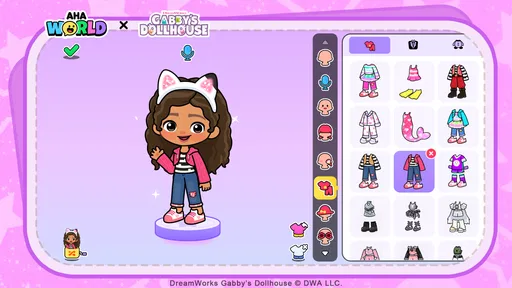
I find Aha World easiest to judge as a little stage for make-believe rather than as a conventional game with a finish line. Its appeal is in dressing characters, arranging scenes and inventing what happens next. That makes it a natural fit for a shared tablet or a quiet stretch at home: one child can set up a story, then pass the device to someone else to add a character or change the scene. The fun comes from the handoff as much as from any single activity.
The game is educational, but I would not expect it to teach a specific school subject in the way a lesson app does. Its more useful contribution is open-ended play: choosing looks, making visual choices and building a story from the pieces on screen. That can give children an easy starting point when they want to play together but cannot agree on a board game or shared activity. One child can propose a setting; another can decide what a character wears or what happens next.
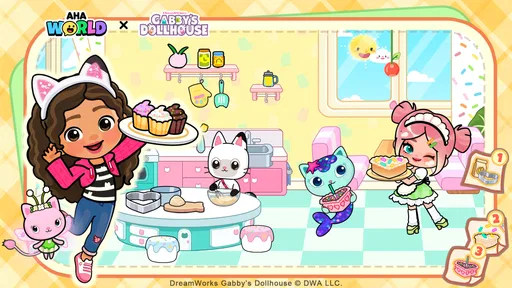
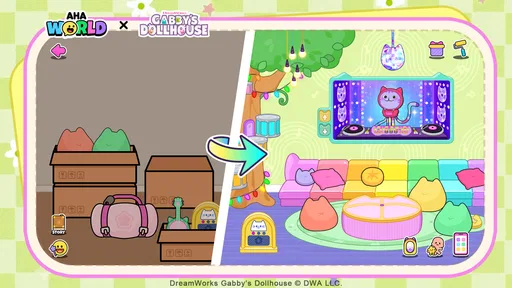
Aha World has also brought Gabby’s Dollhouse into its play world, which gives fans of that show a recognizable point of entry. I see that as a helpful prompt, not a requirement. A child who knows the characters may arrive with ideas already, while a newcomer can still use the broader role-play and scene-making premise without needing to know the show.
A practical household routine is to let one child choose the scene and another contribute a character or story beat, then swap roles the next time. This avoids turning the device into a tug-of-war over who gets to control every choice. It also makes the game feel more collaborative than simply passing the screen back and forth while each person plays alone.
On a family device, I would agree on a simple turn-taking rule before opening the game. For example, one person can make the first set of choices and the next person can continue the story. That small boundary matters because creative play can be surprisingly personal: a child may care about the character they dressed or the scene they arranged, even when there is no competitive score involved.
I would also avoid assuming that one shared device automatically means separate spaces for each child. The safest expectation is to coordinate directly: decide who is playing, what they are changing and when the device is handed over. If children are likely to overwrite or rearrange each other’s ideas, take turns starting fresh stories rather than treating one shared session as a permanent joint project.
This is a useful distinction from many puzzle or learning games, where the next step is clear and progress can be measured. Here, the value is in the process, so a child may be perfectly happy to rebuild a scene rather than preserve a record of it. If your household needs separate profiles, strict progress boundaries or a structured curriculum, choose an option designed around those needs instead of expecting this kind of imaginative play to provide them.
The game is free to download, but it includes in-app purchases ranging from $0.99 to $99.99 per item. For a child using a shared device, I would make purchase expectations clear before handing it over and use the device’s own purchase safeguards where appropriate. The listed prices cover a wide range, so it is worth treating any purchase prompt as a moment for an adult to decide rather than an invitation for a child to tap through.
That is not a reason to rule the game out; it is a reason to make the household boundary explicit. I would tell a child which parts they can explore on their own and that buying anything requires permission. This is particularly useful when a device is also used by adults, siblings or guests, since everyone may have different expectations about spending and access.
The app is rated for Everyone, which makes it broadly approachable for a family audience, but that rating does not replace a parent’s judgement about a particular child or device. I would start by playing nearby, see how the child responds to the open-ended format, and decide whether it suits their age and attention. Some children enjoy making up stories; others would rather have clear goals, instructions and a defined sense of completion.
Aha World is at its best when children have room to make small decisions without needing an adult to direct every step. I would offer a prompt rather than a script: “Who is arriving?” or “What should happen after this?” That keeps the child in charge while helping if they are unsure where to begin. It is also an easy way for siblings to cooperate, because each can contribute an idea without needing to agree on every detail.
There is a trade-off, though. Open-ended play can lead to a quick “What do I do now?” from a child who expects a level, objective or reward loop. In that situation, I would join in briefly and suggest a simple story challenge, such as choosing a character and giving them a reason to visit the scene. If the child still wants clearer tasks, a guided educational game or a conventional dress-up game with explicit goals may be a better match.
For short everyday sessions, I would treat the game as a creative break rather than a reliable timer-based activity. A child can make a quick character choice while waiting at home, or spend longer building an imagined scenario when there is no rush. The important point for a shared household is to agree on when the session ends, because a story with no fixed endpoint can be hard to stop at a moment chosen by someone else.
It can also help to give children different roles instead of asking them both to control the screen at once. One can narrate while the other makes choices, then they can switch. That simple arrangement uses the game’s story-making focus and reduces the friction that often comes from two people reaching for the same controls. It is a more natural fit here than trying to turn the experience into a competitive contest.
IHUMAN (SG) PTE. LTD. develops the game, and its educational label makes sense to me when understood broadly: children practise imagination, choice-making and telling a story through play. I would not present it as a substitute for reading practice, a classroom activity or an adult-led conversation. Its strength is that a child can explore ideas visually and make a scene feel like their own.
The Everyone age rating is a helpful first signal for parents, but younger players may still benefit from someone nearby, especially when sharing a device or encountering purchase options. For older children, the open format can be relaxing, though those who want deeper strategy or a strong challenge may find it too light. I would choose it for creative play and familiar character appeal, not for demanding gameplay or a measurable learning plan.
One useful way to keep the experience grounded is to ask the child to explain the story they have made. That turns a few taps and visual choices into conversation: who the characters are, what they want and what might happen next. It is a low-pressure use case that makes the game more engaging without pretending the app itself guarantees a particular educational outcome.
The game has an average rating of 4.6 from around 231,000 ratings, and it has passed 50 million installs. I take that as evidence of broad interest, not proof that every child will enjoy its style. It also has about 4,000 written reviews, so there is a substantial audience behind it. For my decision, the more important question remains whether a child likes creating scenes or prefers games that tell them exactly what to do.
Compared with typical educational apps built around quizzes, letters or step-by-step lessons, Aha World gives up some structure in exchange for imaginative freedom. Compared with a simple dress-up title, its role-play framing makes it easier to turn appearance choices into a continuing story. That middle ground is the reason I would try it for a child who likes dolls, characters and make-believe but does not want every activity to feel like school.
The current version is 6.8.1, and the game is free to start, with optional in-app purchases. It was released on January 6, 2023, and requires Android 9 or later. Those details make it straightforward to check whether a device can run it, while the purchase range is the part I would discuss before sharing the screen with a child.
My recommendation is for families looking for a flexible, character-led activity that can work for solo play or a bit of sibling collaboration. It is especially suitable when a child already enjoys dressing characters and inventing scenes, and when an adult is comfortable setting simple turn-taking and spending boundaries. I would skip it for children who need firm instructions, for households that require carefully separated user spaces, or for anyone seeking a focused academic course.
In my view, Aha World earns its place on a shared device when the family treats it as a toy box for stories, not as a lesson plan or a competition. Set a clear purchase rule, agree on turns, and give children a prompt when they run out of ideas. With those expectations in place, its open-ended play is a real strength; without them, the same freedom can make it harder to coordinate or bring a session to a tidy stop.
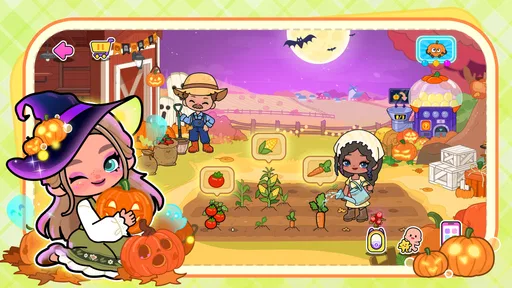
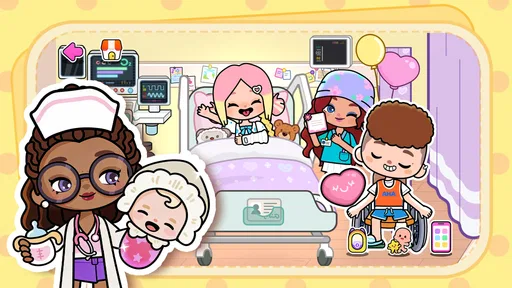
Aha World is a creative play app where you can make characters, dress them up, decorate spaces, and explore interactive scenes. Rather than following a single story or set of levels, you can use its characters, outfits, accessories, and locations to make up your own scenarios. The experience is aimed mainly at children, though anyone who enjoys open-ended doll and world-building games may find it appealing.
The app is generally available as a free download, but access to all of its content may depend on in-app purchases or other optional offers. Some characters, outfits, items, or areas may be available without payment, while additional content can require a purchase. Check the current store listing and in-app details for the latest pricing, and review purchase settings before letting a child play.
Some of the game’s available activities may work without an internet connection after the relevant content has been downloaded, but connectivity requirements can vary by feature and version. An internet connection may be needed for initial installation, updates, store purchases, or content that has not yet been loaded. If offline play matters to you, test the app in airplane mode before relying on it during travel.
Aha World is designed as a child-friendly creative game, with dress-up, character creation, and imaginative play rather than demanding combat or competitive challenges. Parents should still check the current age rating, privacy information, and available parental controls, as these can differ by platform and region. It is also sensible to review in-app purchases and supervise younger children when they use a mobile device.
Aha World is offered for supported Android and iOS devices, but compatibility depends on the operating-system version, device model, and regional store availability. The download may also use more storage over time as the app receives updates or adds content. Before installing, check the app’s store page for current requirements and make sure your device has enough free space for both the initial download and future updates.
On Android, Aha World: Doll Dress-Up Game asks for these permissions.
4.6 out of 5
230,781 reviews
Educational · IHUMAN (SG) PTE. LTD.

Educational4.4 out of 5
Educational4.3 out of 5

Educational4.5 out of 5

Educational4.1 out of 5
Educational3.3 out of 5

Educational4.4 out of 5
Educational4.4 out of 5

Educational3.3 out of 5
Educational4.5 out of 5
Educational4.5 out of 5

Educational4.5 out of 5

Educational4.6 out of 5
Educational4.5 out of 5
Educational3.8 out of 5
Educational4.4 out of 5

Educational4.6 out of 5

Educational4.5 out of 5

Educational4.4 out of 5



Gamesive reviews games on its own and is not paid by developers for scores. We do not host game files: the download buttons open the official Google Play and App Store pages. Names, icons and screenshots belong to their owners.