Word Collect - Word Games Fun
Word4.7 out of 5
For Android · Gimica GmbH

 Analysis by Gamesive
I went into Word Kitchen expecting a casual word game, and that is the right way to approach it: a small puzzle break rather than a deep vocabulary course or a competitive brain trainer. Its kitchen framing gives the word-game idea a clear identity, but the real appeal is the familiar pleasure of spotting words and getting a quick mental workout. I would recommend it to someone who enjoys word puzzles and wants an easy game to dip into, while keeping expectations measured about how much can be judged from the game’s basic premise alone.
Word Kitchen is a free word game from Gimica GmbH. The store presents it under the simple label “Word Kitchen,” and its playful food-and-heat framing makes the concept approachable without changing what most players are here for: finding words. I like that the theme sets a light mood rather than making the game sound like a serious study tool. If you want a calm activity between other tasks, that tone is a better fit than a puzzle that demands long, uninterrupted sessions.
The game is listed with a 4.5 average from around 43,000 ratings, alongside roughly 1,400 written reviews and over one million installs. Those figures suggest that plenty of players have tried it, but they should not be treated as a guarantee that its style will suit everyone. Word games are personal: some people love searching for familiar words, while others quickly want a more demanding vocabulary challenge or a clearer sense of progression.
It is rated for Everyone, which makes it broadly accessible as a category of entertainment. That rating is not a promise that every player will find it equally engaging, nor does it tell me how a particular person will respond to the puzzles. I would think of it as a low-pressure option to try with family members or during a quiet break, rather than as a game designed around head-to-head competition.
A realistic use for Word Kitchen is a short pause while waiting for an appointment or taking a break from reading. A word puzzle can occupy attention without requiring the setup or commitment of a longer game. I find that kind of use especially appealing when I want to do something more active than scrolling, but I do not have enough time or concentration for a complicated strategy game.
For a better experience, I would treat each visit as a small session and stop when the puzzle stops feeling enjoyable. That is more useful than trying to turn every game into a streak or a daily obligation. If you are playing around other people, it can also make a relaxed shared activity: one person can suggest possible words while another checks them in the game. The trade-off is that this style of play depends on enjoying the search itself; a theme alone cannot make a word puzzle satisfying if you dislike looking for letter combinations.
The central appeal of a word game is usually its balance between recognition and effort. Familiar words can make a puzzle feel welcoming, while less obvious combinations give the player a reason to pause and think. I would judge Word Kitchen by whether that balance remains pleasant over repeated sessions, not by whether every puzzle feels difficult. A game that is too easy can become routine; one that constantly stalls the player can make a casual break feel like work.
One practical approach is to change how you search when you get stuck. Instead of repeatedly trying the same obvious short words, scan the available letters from a different starting point and consider less common combinations. Taking a brief pause can help too: when I stare at the same arrangement for too long, I tend to recycle the same guesses. This is a general word-puzzle habit rather than a claim about a special tool in this game, but it is a useful way to keep the experience from becoming frustrating.
Another helpful distinction is between wanting a relaxing puzzle and wanting to improve vocabulary. Word Kitchen may be enjoyable as a word-finding pastime, but I would not rely on it as a structured learning program. A player who wants definitions, spelling instruction, or a planned progression through vocabulary should choose an educational app built specifically around those goals. For casual recognition and mental engagement, a straightforward word game is a more natural fit.
The game is free to download, with optional in-app purchases listed from $0.99 to $25.99 per item. That is the clearest basis for thinking about spending: you can start without paying, while purchases are available inside the app. I would decide in advance whether I am comfortable with optional spending and avoid buying anything simply because I feel impatient during a puzzle.
Those purchase details alone do not establish whether paying changes puzzle difficulty, removes interruptions, grants extra help, or affects progress. I would not assume that Word Kitchen is pay-to-win, but I also would not claim that purchases have no influence on the experience. The fair conclusion is narrower: the game has optional paid items, and the listed prices vary. If spending is a concern, check the purchase prompts carefully and use the device’s purchase controls before handing the game to a child.
The same caution applies to competitive fairness. I would not describe the game as a contest with rankings or matchmaking based on the information available here. If your main reason for installing a word game is to challenge friends on equal terms, compare it with a title that clearly explains its multiplayer and scoring systems. Word Kitchen is easier to recommend as a solo, casual choice than as a competitive platform.
There are also ordinary practical questions that matter when choosing any mobile game, such as whether a particular device supports it and whether the current build behaves well on that device. The listed current version is 1.13.0, and the minimum operating-system requirement is 7.0. Those details are useful when checking compatibility, but they do not tell me how the game performs on every phone or tablet. I would install it on the device I plan to use and judge responsiveness and comfort there rather than assuming the same experience across hardware.
Compared with a crossword, Word Kitchen is better suited to someone who wants to look for words without first working through clues and general-knowledge references. Compared with a word-search game, its appeal is less about tracing a visible grid and more about testing possible words against a puzzle’s available letters. Those are broad genre differences, not a claim that every individual puzzle follows a particular layout or rule.
That makes the choice fairly simple. Pick Word Kitchen if the act of finding words is the fun part and you want a themed, approachable entry point. Choose a crossword if you enjoy clues and wider factual knowledge, or a word-search title if you prefer visual scanning. If you want a social match, a timed tournament, or a carefully structured vocabulary curriculum, look for a game that explicitly centers that feature instead of expecting this one to fill every role.
One non-obvious trade-off in casual word games is that a friendly theme can make a familiar mechanic feel more inviting, but it cannot replace variety in the puzzles. I would pay attention to whether I still want to return after the novelty of the kitchen setting wears off. Another is that a game can be suitable for short breaks without being ideal for long sessions: repeated word searching may feel repetitive if you prefer changing objectives. These are useful questions to ask yourself early, before investing time or money.
I would suggest Word Kitchen to casual players who already enjoy word puzzles, people looking for a low-commitment activity, and families wanting a broadly accessible game to try together. Its free entry makes it easy to test whether the style clicks before considering any optional purchases. Gimica GmbH is the developer, and the game’s established audience gives a new player a reasonable reason to take a look, though popularity is not a substitute for personal fit.
I would skip it if you dislike word-searching altogether, want a detailed language-learning path, or need a competitive mode to stay interested. I would also be cautious about recommending it as a long-term challenge to someone who needs every game to introduce new mechanics or steadily raise the stakes. A light word game can be a pleasant routine without becoming a demanding hobby, and that is a strength only when it matches what you want.
Word Kitchen’s strongest case is its straightforward role: a free, approachable word game with a playful kitchen identity and a large existing audience. Its 4.5 average rating is encouraging context, not a promise of universal approval. I would try it for short, relaxed puzzle sessions, keep purchases deliberate, and move on if the word-finding loop stops being fun. That is a fair way to approach a game whose appeal is simple: it gives word-puzzle fans an easy place to spend a few spare minutes.
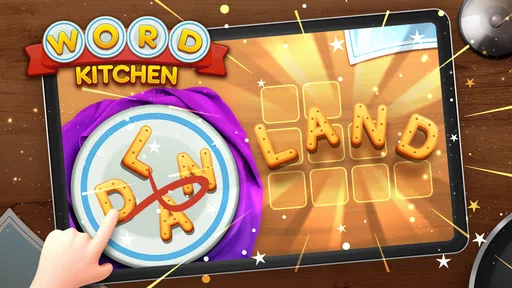
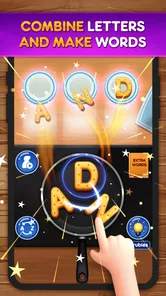
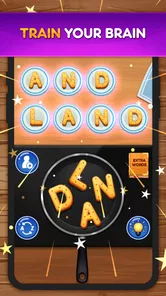
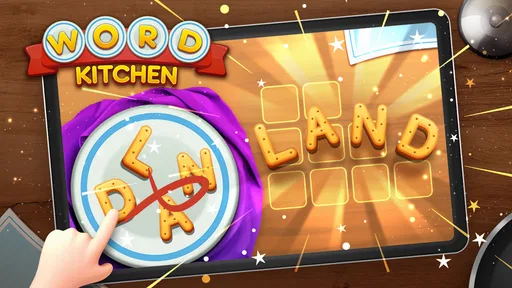
Word Kitchen is a word puzzle game built around finding words from a set of letter tiles. You swipe or connect letters to fill empty spaces in a crossword-style grid, with the aim of completing each level. The food and kitchen theme gives the puzzles a light, casual feel, while later stages can require more careful combinations and a broader vocabulary.
Word Kitchen is generally offered as a free-to-download game, so you can try its basic puzzles without paying upfront. Like many mobile games, it may include advertisements, optional in-app purchases, or both; availability and pricing can differ by version, store, and region. Check the app’s store listing before downloading, and review purchase settings if children use the device.
Many word puzzle levels may be playable offline once the game is installed, which can make Word Kitchen convenient for travel or a short break without Wi-Fi. However, features such as advertisements, rewards, updates, leaderboards, or purchase processing may need an internet connection. Offline behavior can vary by version, so test a level in airplane mode if reliable offline access matters to you.
Word Kitchen’s simple letter-matching controls and short puzzle levels can make it approachable for beginners and older children who enjoy spelling games. Difficulty may increase as the grids become more challenging, and some answers may depend on vocabulary or word patterns players have not encountered before. Check the store’s age rating and in-app purchase details, and consider supervising younger players around ads.
Before downloading, confirm that the listing is for the intended Word Kitchen game and is compatible with your Android or iOS device. Review the developer, latest update date, ratings, permissions, privacy information, and whether the game contains ads or in-app purchases. The exact features can change between versions, so the current app-store listing is the best source for device requirements and availability.
On Android, Word Kitchen asks for these permissions.
Word Kitchen is also available in 1 other languages on our site.
4.5 out of 5
42,769 reviews
Word · Gimica GmbH
Word4.8 out of 5

Word4.7 out of 5

Word4.9 out of 5

Word4.9 out of 5
Word4.8 out of 5

Word4.8 out of 5

Casual4.5 out of 5
Card4.6 out of 5

Casual4.5 out of 5
Word4.4 out of 5
Word4.7 out of 5

Word4.5 out of 5

Word4.9 out of 5
Word4.7 out of 5
Word4.8 out of 5
Word4.7 out of 5
Word4.9 out of 5
Word4.9 out of 5
Word4.9 out of 5

Word4.5 out of 5

Word4.1 out of 5

Word4.6 out of 5



Gamesive reviews games on its own and is not paid by developers for scores. We do not host game files: the download buttons open the official Google Play and App Store pages. Names, icons and screenshots belong to their owners.