Word Collect - Word Games Fun
Word4.7 out of 5

For Android & iOS · Zynga
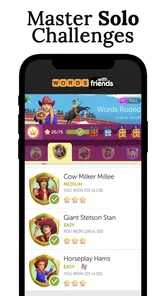
 Analysis by Gamesive
Words With Friends Word Game takes the familiar pleasure of fitting words together and gives it a relaxed, social feel. Rather than surrounding its puzzles with a busy fantasy world or a dramatic story, it makes the board itself the focus: letters, possible plays, and the satisfying moment when a word finds its place. I like that clear direction. It makes the game easy to approach while leaving room for a match to become a quiet test of vocabulary and judgment.
At its heart, Words With Friends is a multiplayer crossword and word puzzle game from Zynga. The idea is immediately understandable: make words from letter tiles and place them across a shared board. That simple premise is the source of its appeal. You do not need to learn an elaborate setting before playing; the board gives you a clear problem to think about, and every turn invites you to weigh a safe word against a more ambitious one.
The game’s mood is shaped by its restraint. Word puzzles can feel intense when they rely on a countdown or a complicated challenge structure, but this one is built around taking turns with another player. That gives a match a more conversational rhythm. I can focus on the letters in front of me, consider how a move might open the board, and then let the other player take their turn. The result feels less like a race and more like an ongoing exchange.
That approach also makes the game welcoming to different kinds of players. Someone who enjoys language can settle in for the pleasure of finding words, while a more strategic player can think about placement and the options a move leaves behind. The appeal is not limited to experts, either. A modest word can still be satisfying when it fits neatly into the puzzle, and a strong play feels rewarding without needing a complicated explanation.
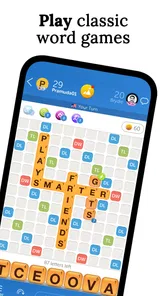
The board is the game’s whole stage, and that focus works in its favor. The pieces and crossing words create the visual story of a match as it develops. There is no need for a separate setting to explain why the next move matters: the changing pattern of letters does that naturally. For me, this uncluttered presentation helps keep attention where it belongs, on the puzzle and the person on the other side of it.
The art direction of Words With Friends is best understood through what it chooses not to do. It does not ask the player to explore a detailed landscape or follow a cast of characters. Instead, it treats the board as a friendly, functional space. This makes the visual language easy to read and gives the words themselves room to stand out. In a game about spelling and placement, that clarity matters more than elaborate decoration.
There is a pleasant sense of order in watching the board fill. At first, the available space can feel open, with several possible directions for a word. As the match proceeds, each placement changes the shape of the puzzle. New crossings appear, open stretches become tighter, and the board begins to feel like a record of the conversation between two players. That gradual transformation is a small but effective form of visual storytelling.
The setting also supports the game’s accessible tone. A crossword board is instantly recognizable, so the rules feel connected to a familiar kind of puzzle even when the match becomes competitive. That familiarity lowers the barrier to starting a game, while the shared board provides enough complexity to keep later turns interesting. I appreciate how the presentation lets those two qualities sit together: approachable at a glance, but not necessarily simple once you start thinking several moves ahead.
Because the game’s identity is so closely tied to language, the strongest visual moments come from the words themselves. A clever placement can make a plain-looking board suddenly feel lively, especially when one word connects with another and creates a satisfying chain of crossings. It is a modest kind of spectacle, but a fitting one. The game does not need explosions or dramatic scenery to make a good turn feel memorable; the puzzle supplies its own payoff.
This restrained design is particularly useful for a game that players may return to for repeated matches. A clear board makes it easier to keep track of the position without feeling that the screen is competing for attention. The design supports the activity instead of overwhelming it. In my view, that is the right choice for a word game: atmosphere should give the player a comfortable place to think, not distract from the letters that make each turn matter.
The game’s mood is shaped as much by its pace as by its visual style. Since players take turns, a match naturally includes moments of action and moments of waiting. That rhythm gives each move room to breathe. Instead of demanding constant attention, the format encourages a player to return, inspect the board, and decide what to do next. It makes the game feel compatible with a casual routine rather than requiring a long, uninterrupted session.
Sound is not the main attraction here; the language puzzle is. That suits the overall design. A word game benefits from an atmosphere that leaves mental space for concentration, and the board provides the activity’s central feedback. The pleasure comes from spotting a possible word, checking how it fits, and seeing the shared pattern change after a play. The experience feels deliberately low-key, which helps the game remain an easy place to focus.
The turn-based rhythm also gives social play a distinctive character. A move is not only a puzzle solution; it is a response in an exchange that unfolds over time. One player places a word, and the next has to work with the board that results. That back-and-forth can make even a straightforward match feel personal. I enjoy how the game’s pacing gives that interaction space without forcing every turn to become a high-pressure event.
There is a useful balance between steady progress and open-ended thinking. A player can make a quick decision when an obvious word presents itself, or spend longer considering what the placement might mean for later turns. That flexibility helps the game serve both relaxed and more competitive moods. The same board can be a casual diversion one moment and a small strategic challenge the next, depending on how much thought you choose to bring to it.
The pacing does ask for patience. A multiplayer, turn-based word puzzle is not designed around constant action, so players looking for a fast sequence of immediate rewards may find the pauses less exciting. I see those pauses as part of the game’s identity rather than a flaw in its concept. They make each turn feel like a deliberate contribution to the board, and they give a match room to continue at a comfortable pace.
The mechanics are straightforward enough to understand, but the board creates decisions that reward attention. You are not only looking for a word; you are considering where it can go and how it will affect the shared puzzle. That combination of vocabulary and placement gives the game its staying power. Finding a word is satisfying, but finding a place where that word fits well is what makes a turn feel considered.
The crossword structure naturally produces a different kind of challenge from a solo word search. The board is shared, so every move changes the possibilities available to both players. That creates a gentle strategic tension: a placement can solve the immediate problem while also shaping what comes next. I like that the game’s main idea supports this depth without making the experience feel inaccessible. The rules stay centered on words, while the board supplies the layers of decision-making.
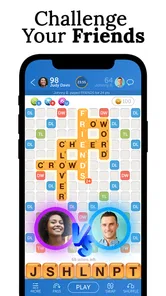
The social format is a strong match for this kind of puzzle. Wordplay is easy to enjoy together because both players can see how the match develops. Each turn leaves a visible mark, and the growing crossword becomes a kind of shared creation. The result is more engaging than simply completing a fixed puzzle alone, but it still preserves the quiet concentration that makes word games appealing in the first place.
Words With Friends is free to play and includes optional in-app purchases, with individual items priced from ninety-nine cents to one hundred forty-nine dollars and ninety-nine cents. That range makes it worth paying attention to purchase choices, particularly if you prefer to keep a casual game completely free. The core appeal, though, remains the word puzzle itself: making a play, seeing the board change, and finding another opportunity in the letters available.
The game has a 4.1 average rating from around five hundred twenty-seven thousand ratings, and it has been installed over ten million times. Those figures suggest a substantial audience for its particular style of play, but the more important point is how clearly its design communicates what it offers. It is a word game for people who enjoy taking turns, building a crossword together, and finding a little strategy in familiar letter tiles.
Its age rating is Everyone, and the game’s basic appeal is easy to grasp across a broad range of players. It is also a long-running release, first released on November 7, 2017, with version 63.00.04 currently available. Those details fit a game whose central idea is deliberately durable: a shared board, a set of letters, and the challenge of making the best word you can from the position in front of you.
What I enjoy most is the way the different parts of the experience support one another. The restrained art direction keeps the board readable, the steady pace gives players time to think, and the crossword mechanics make every placement part of a larger exchange. Nothing needs to be louder than the puzzle. That consistency gives the game a coherent mood: relaxed, thoughtful, and lightly competitive without turning the act of playing into a spectacle.
That mood will not be for everyone. Players who want a strong narrative, an elaborate world, or nonstop action may find the experience too focused on its basic board. But for anyone who likes language puzzles, that focus is a benefit. The game knows what it is, and it does not bury the wordplay beneath unrelated systems. I find that confidence refreshing, especially in a casual game designed to make repeated matches feel comfortable.
Words With Friends is a good fit when you want a multiplayer word game that is easy to understand but still gives you reasons to pause and plan. It combines familiar crossword logic with the changing possibilities of a shared match, then lets the players set the tempo. The presentation is clear, the atmosphere is calm, and the mechanics remain the star from the first move to the last.
My overall impression is that this is a steady, personable word puzzle rather than a flashy one. Its appeal comes from the small pleasures of language: spotting a useful word, finding a satisfying placement, and seeing how another player responds. If that sounds like your kind of game, Words With Friends offers a welcoming way to put your vocabulary and board-reading instincts to work, one turn at a time.
Words With Friends is a turn-based word game in which players take turns forming words on a letter-tile board, somewhat like classic crossword-style board games. You can challenge friends or play with available opponents, depending on the options offered in your version. The game is free to download, while optional purchases and ads may be included. Its features and availability can vary by device and region.
Each player uses a rack of letter tiles to make a word on the board, connecting new words to tiles already in play. Letter and board spaces can increase a word’s score, so both vocabulary and placement matter. After a turn, tiles are replenished, and play continues until the game ends under its rules. The app generally explains the basics, but checking the scoring and game options helps avoid surprises.
Yes. The game is designed for social, turn-based matches, so players can take turns at their own pace rather than needing to be online simultaneously. Depending on the current version, you may be able to find opponents through contacts, invitations, or in-game matchmaking. Some social features may require an account or internet access, and the available ways to connect can differ across platforms and regions.
An internet connection is generally needed to start or synchronize online matches, connect with opponents, and access account-related features. Because turns are asynchronous, you do not usually have to remain online while another player considers a move. Offline access may be limited, and availability can depend on the app version and device. Before downloading, check the store listing for current connectivity requirements and ensure your device meets them.
Words With Friends is typically available as a free download, but the experience may include advertising and optional in-app purchases. Purchases can vary and may offer items or features within the game; they are not necessarily required to play a standard match. Review the current Google Play or App Store listing for pricing, subscriptions, and purchase details, and use device-level purchase controls if children will be playing.
On Android, Words With Friends Word Game asks for these permissions.
4.1 out of 5
527,337 reviews
Word · Zynga
Word4.8 out of 5
Word4.7 out of 5

Word4.9 out of 5

Word4.9 out of 5
Word4.8 out of 5
Word4.8 out of 5

Racing4.6 out of 5
Card4.8 out of 5

Sports4.4 out of 5
Word4.7 out of 5

Word4.5 out of 5

Word4.9 out of 5
Word4.7 out of 5
Word4.8 out of 5
Word4.7 out of 5
Word4.9 out of 5
Word4.9 out of 5
Word4.9 out of 5
Word4.5 out of 5

Word4.6 out of 5
Word4.9 out of 5



Gamesive reviews games on its own and is not paid by developers for scores. We do not host game files: the download buttons open the official Google Play and App Store pages. Names, icons and screenshots belong to their owners.