
Offline Games No WiFi internet
Casual4.7 out of 5

For Android · Gimica GmbH
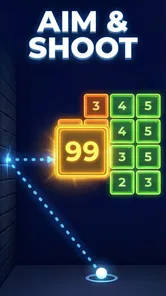
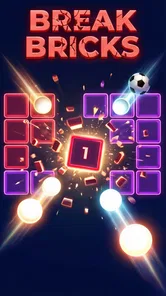



 Analysis by Gamesive
I like casual games that make sense within seconds but still give me a reason to think about the next move. Ball Bounce is built around that simple appeal: aim a shot, send balls ricocheting through a field of bricks, and try to make one launch do as much work as possible. It is easy to pick up for a short break, though the appeal depends on enjoying repetition and small aiming decisions rather than a story or a large collection of modes.
At first glance, the game’s pace sounds entirely automatic: launch balls and watch them bounce. In practice, I find the satisfying part is choosing the angle. A shot that clips a useful edge or travels through a cluster can keep bouncing and clear more bricks than a direct hit. That makes each turn a compact prediction exercise: I’m not just aiming at what is in front of me, but trying to imagine where the balls will travel afterward.
That rhythm suits brief sessions. I can play a turn while waiting for a kettle or filling a few spare minutes, without needing to remember a complicated plot or build a long-term strategy. The trade-off is that the same basic loop can feel familiar quickly. If I want action that keeps changing its rules, or a game where progress comes from exploring new places and abilities, this is not the one I would choose.
The store describes the game as “Ball Bounce,” and that is also the short name shown for it. It is a casual brick-breaking game from Gimica GmbH. The central attraction is the contrast between a simple input and the unpredictable-looking chain of rebounds that follows. I would recommend it most to someone who enjoys trying to improve a small decision from one turn to the next, rather than someone looking for elaborate controls.
A quick game can still reward attention. I get more out of Ball Bounce when I pause briefly to look for a path that will carry balls through several targets instead of merely sending them toward the nearest brick. A useful habit is to consider the likely return route as well as the first impact: an angle that seems less obvious at launch can create a longer sequence of collisions. This is a practical way to make the aiming feel deliberate without turning every move into a lengthy calculation.
That is also where the game differs from a typical one-touch time-killer. Its controls and premise are approachable, but the player’s choice of direction matters to the result. The tension is modest and immediate: a good angle can feel clever, while a poor one can make a turn seem wasted. I find that more engaging than tapping passively through a stream of animations, although it remains a light experience rather than a demanding puzzle game.
A realistic use for Ball Bounce is a short pause between tasks. If I have a few minutes before an appointment or am waiting for a friend, I can start playing without setting aside a dedicated block of time. The turn-based feel makes it easier to stop after a small stretch than it would be with a game built around long matches. Still, I would avoid opening it when I need to focus on something else: even a simple aiming game can invite “one more turn” when I want to improve a shot.
For a more thoughtful session, I would pay attention to which angles tend to produce useful rebounds rather than firing as quickly as possible. That gives each attempt a small purpose and helps keep repetition from feeling empty. If I am tired and only want something soothing, I can play casually; if I want to stay engaged, I can treat each launch as a little geometry problem. The game’s strength is that it can serve both moods without asking me to learn a complicated system.
Compared with match-and-clear games, Ball Bounce puts more emphasis on trajectory than on spotting a group of matching objects. Compared with endless runners, it is less about reacting to hazards at speed and more about choosing a direction before the action unfolds. That makes it a better fit for someone who likes visual cause and effect but does not want constant movement or a long tutorial.
The reverse is true if variety is the priority. A casual game with distinct stages, changing objectives, or a broader set of activities may hold attention longer for players who tire of repeating a central mechanic. Ball Bounce’s appeal is narrower and clearer: launch, watch the chain of rebounds, and make a better choice next time. I see that focus as an advantage for quick play, but also as the main reason some people will move on.
In a game built around repeated launches, small delays or interruptions would matter because they break the link between aiming and seeing the result. I would judge a session by whether the shot resolves clearly and whether I can follow the rebounds, not by expecting the pace of a high-speed action game. The game’s basic concept is easy to understand, so a smooth, readable turn matters more than a large number of visual effects.
I would also be realistic about playing for a long stretch. The same compact loop that makes Ball Bounce convenient can become monotonous when used continuously. After several rounds, I would take a break or switch to something with a different kind of challenge rather than expect the game to keep supplying new experiences. That is not a flaw unique to this title; it is the natural cost of a focused, repeatable mechanic.
If an interruption pulls me away mid-session, the sensible expectation is to return when convenient and resume playing casually, rather than treating a run as a major commitment. I would not plan around a long narrative or a carefully managed campaign here. For players who need a game to preserve complex progress across extended sessions, a deeper game may be a better match. Ball Bounce is at its most useful when I can simply open it, play a little, and leave.
Ball Bounce is listed for devices running Android 7.0 or later, so an older Android device may not meet its stated operating-system requirement. That is the clearest practical compatibility check I would make before installing. I would not infer battery use, storage needs, or performance on a particular handset from the game’s simple premise alone; those can vary by device and how it is used.
Because the play depends on judging angles and following the balls, screen clarity and comfortable touch control matter more to me than raw processing power would in a complex 3D game. On a small display, I would take care to aim deliberately instead of making rushed gestures. If touch input feels awkward on a particular device, the game’s central skill—choosing a useful direction—will naturally become less enjoyable.
There is no need to approach the game as a demanding, high-commitment hobby. Its light format is appealing for spare moments, but anyone who wants extensive customization, competitive depth, or a substantial story should look elsewhere. Likewise, if I’m trying to avoid optional spending entirely, I would keep its purchase model in mind: the game is free to download, with in-app purchases priced from $0.99 to $3.49 per item. I would decide in advance whether I want to spend, rather than letting a casual session turn into an unplanned purchase.
I would suggest Ball Bounce to a friend who likes aiming, bouncing-object puzzles, and games that can be understood without a long introduction. It may also suit someone who wants a low-pressure alternative to reflex-heavy casual games. A person who enjoys testing one small adjustment at a time—changing an angle and seeing how the result differs—will probably find more to appreciate than someone who only wants constant novelty.
I would skip it if I wanted a broad campaign, a social experience, or a puzzle game with a steadily expanding set of rules. It is also not ideal when I need a clear endpoint after exactly one short turn: its repeatable loop can make it tempting to continue. That is a matter of personal preference, but it is worth knowing before choosing it as a way to manage a very brief break.
The game has an Everyone age rating, which makes it broadly suitable as a light casual choice. Its reception is also substantial: it holds a 4.5 average from around 142,000 ratings, and has passed 5 million installs. Those figures suggest many players have tried it, but I would still base a decision on whether the bouncing-brick mechanic sounds enjoyable to me; popularity cannot make repetition appealing to someone who dislikes it.
Ball Bounce is free to start, and I see its value in how quickly it gets to the point. The current version is 1.13.0, and the game has been available since December 23, 2021. Its developer, Gimica GmbH, has kept the identity straightforward: a casual game centered on launching balls into bricks. For me, that clarity is more persuasive than a promise of endless novelty, because I know what kind of session I am choosing.
My performance verdict is measured rather than dramatic. Ball Bounce is best treated as a small, repeatable aiming game, not as a technically ambitious or content-heavy release. Its pace should appeal when I want immediate play, and its rebound planning gives the simple premise a little more thought than a purely passive time-killer. The main limitation is just as clear: if the core loop stops being satisfying, there is little reason to keep playing.
I would try it if I wanted a free casual game for short breaks and enjoyed working out a better shot through trial and observation. I would choose a more varied puzzle game for longer sessions, or a richer game if I wanted progression and changing objectives. For the right player, though, the appeal is easy to understand: a few seconds of aiming can lead to a surprisingly busy sequence of rebounds, and that small payoff is enough to make another turn feel worthwhile.
Ball Bounce is a casual arcade-style game built around guiding a bouncing ball through a series of obstacles and platforms. You generally control the ball by tapping, swiping, or using on-screen controls, depending on the version available on your device. The goal is to keep moving, avoid hazards, and reach the end of each stage. Check the store listing for the specific controls and features of the edition you plan to download.
The basic idea of Ball Bounce is easy to understand, so it can appeal to players looking for short, straightforward gaming sessions. Its challenge usually comes from timing movements and reacting to obstacles rather than learning complicated rules. Difficulty and presentation can vary between games with this title, however, so parents should review the age rating, screenshots, and content details on the app-store page before letting a child install it.
Whether Ball Bounce works offline depends on the particular version and its features. A simple single-player edition may allow you to play levels without a connection, while ads, online rankings, events, or other services may need internet access. If offline play matters to you, check the listing and recent user reviews, then test the game in airplane mode after installation. Avoid assuming every version supports offline play.
The price and monetization model can differ because more than one app may use the name Ball Bounce. Some editions are free to install and may show advertisements or offer optional purchases, while others may have different terms. Before downloading, review the store page for the price, in-app purchase details, and advertising disclosures. You can also check device settings or store controls for options to limit purchases, especially on a shared device.
First confirm that the developer, screenshots, and description match the Ball Bounce game you want, since titles and features may differ across listings. Check the age rating, required Android or iOS version, download size, permissions, privacy information, and recent reviews. Make sure your device has enough storage and is compatible. Download through Google Play or the Apple App Store, and review the app's permissions rather than granting access that seems unrelated to gameplay.
On Android, Ball Bounce asks for these permissions.
4.5 out of 5
142,273 reviews
Casual · Gimica GmbH

Casual4.2 out of 5

Casual4.3 out of 5

Casual4.6 out of 5

Casual4.8 out of 5

Casual4.6 out of 5

Casual4.7 out of 5

Casual4.5 out of 5
Card4.6 out of 5

Word4.5 out of 5
Word4.4 out of 5
Casual4.7 out of 5

Casual4.6 out of 5

Casual4.2 out of 5

Casual3.2 out of 5

Casual4.7 out of 5

Casual4.7 out of 5

Casual4.3 out of 5

Casual4.7 out of 5
Casual4.5 out of 5
Casual4.8 out of 5

Casual4.6 out of 5

Casual4.9 out of 5



Gamesive reviews games on its own and is not paid by developers for scores. We do not host game files: the download buttons open the official Google Play and App Store pages. Names, icons and screenshots belong to their owners.