
Ball Sort Puzzle - Color Game
Puzzle4.9 out of 5

For Android · SayGames Ltd
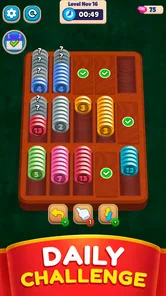
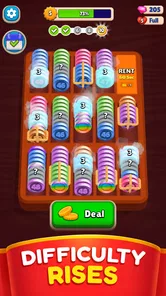
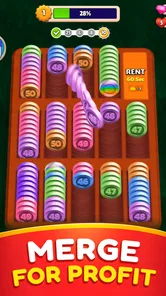

 Analysis by Gamesive
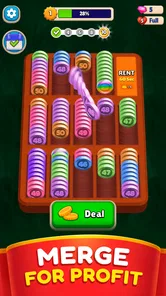
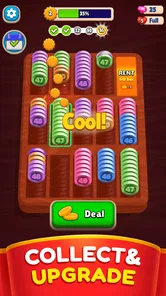
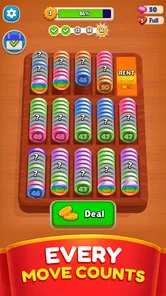
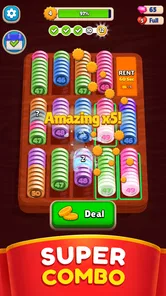
I like puzzle games that make me think without asking me to learn a long rulebook, and Pocket Sort: Coin Merge Puzzle gets its appeal across quickly. It is a free puzzle game from SayGames Ltd built around sorting and combining coins by color. That simple premise makes it easy to try in a spare moment, though the real question is whether its small decisions stay satisfying after the novelty wears off. My impression is that it suits players who enjoy tidy, deliberate sorting more than people looking for a story, a sprawling campaign, or action that demands constant attention.
The basic idea is approachable: look at the coins, notice which colors belong together, and work toward a more orderly arrangement. The challenge comes from thinking ahead rather than reacting quickly. A move that seems convenient now can leave the remaining coins awkwardly placed, so I find it more rewarding to pause and scan the whole board before committing. That makes the game feel closer to a compact sorting puzzle than to a reflex test.
The store calls it Pocket Sort, and that shorter name fits the experience: the format is easy to understand and naturally suited to short sessions. I would not treat “pocket” as a promise that every round takes only a few seconds, though. A quick puzzle can stretch when I start weighing several possible moves, especially if I want to avoid undoing my own progress. The game’s pace is therefore best described as self-directed: I can move briskly, but I get more out of it when I think first.
That slower decision-making is also the main appeal for me. I can pick it up when I have a brief break and focus on one small problem without needing to remember a plot or manage a complicated set of controls. It is a good fit for someone who enjoys organizing objects into a clean result. If you prefer puzzles with wordplay, spatial exploration, or a steadily unfolding narrative, the coin-sorting premise may feel too narrow.
Sorting games often look easier than they are because every item has an obvious destination. The useful question is not just where a coin belongs, but whether moving it now helps keep later choices open. I recommend checking which colors are accessible and considering what a move will expose or obstruct before tapping. This small habit makes the puzzle feel more intentional and can reduce the familiar cycle of making a quick move, spotting a better route, and wishing you had waited.
One practical way to play is to treat each move as a choice between immediate neatness and future flexibility. If a move creates a cleaner-looking area but leaves fewer useful options, it may be a poor trade. That is a subtle but meaningful source of thought in a game with a straightforward premise. It gives the player a reason to slow down without adding complicated instructions or requiring specialist puzzle knowledge.
For an everyday example, I can imagine opening it while waiting for a drink or taking a short pause between tasks. I would first survey the colors, make a couple of moves, and stop once the arrangement feels resolved or I need to return to what I was doing. That kind of interruption-friendly play is where a focused sorting puzzle can work well: there is one clear objective in front of me, rather than a long sequence of story events to keep in mind.
It is less suitable when I have only a few seconds and need to put the phone away immediately. Even a simple board can invite a final bit of planning, and leaving mid-thought is not as satisfying as completing a tidy sequence. Nor would I choose it as my main game for a long commute if I wanted a changing world or a broad range of activities. The appeal is concentrated in the sorting itself, so players who tire of repeating one central idea should keep that expectation in check.
There is a difference between playing casually and pushing through several puzzles in one sitting. In a short session, the clean visual objective can feel calming; during a longer one, I would pay attention to whether I am still planning or simply tapping through familiar moves. The main heavy-use trade-off is mental repetition, not a need for elaborate strategy. If the loop starts feeling automatic, taking a break is likely more useful than trying to force a longer session out of it.
I also find that deliberate play is a better approach than trying to speed-run each arrangement. A quick scan before moving can help preserve options, while a brief pause after a few moves gives me a chance to reassess the colors still in play. This is not a claim about a special feature; it is a simple workflow for getting more enjoyment from the puzzle. The game rewards attention to the board, so rushing can make a manageable challenge feel needlessly frustrating.
For players who like to compare options within the puzzle genre, Pocket Sort occupies a narrower lane than match-style games that emphasize chains and spectacle. It is also different from word puzzles, where progress depends on vocabulary, and from large logic games that may ask for longer concentration. Here, the draw is the visible order emerging from colored coins. That makes it a reasonable choice when you want a direct sorting task, but a weaker one if variety between puzzle types matters more to you than a consistent central mechanic.
I would keep expectations grounded about performance: the core activity is a visual sorting puzzle, so it does not inherently call for the kind of rapid, complex interaction associated with demanding action games. That observation is about the type of play, not a guarantee that every device or session will behave identically. If you are deciding whether to install it, the fairest expectation is a focused puzzle experience rather than a game whose appeal depends on elaborate effects or high-speed competition.
Similarly, I would not assume that every interruption will preserve a particular board state or that recovery works in a specific way. A sensible habit is to finish a move or a puzzle before switching tasks when possible. That is useful advice for any mobile game you are playing in fragments, and it avoids relying on an unconfirmed recovery behavior. The more important point is that the game’s basic loop is easy to understand again after a pause: the colors and their positions give you a visible reminder of the problem.
Device fit matters for a different reason too. The minimum operating-system requirement is version 8.0, which gives the game a broad compatibility baseline, but it does not tell me how it will feel on every older phone. Players using a device near that threshold should consider their own phone’s general responsiveness rather than expecting the same experience from every model. For current devices, the puzzle’s low-complexity style should be an easy match in principle, but I would not make promises about battery use, storage, heat, or performance without device-specific evidence.
I would recommend it to people who enjoy arranging things, spotting a useful sequence, and getting a small sense of completion from a clearer board. It can also suit someone who wants a puzzle that is easy to explain to a friend: sort the colored coins, think ahead, and see whether the arrangement comes together. The game is rated for Everyone, so its stated age suitability is broad. That does not mean every player will find the puzzle engaging, but it does make the concept accessible without relying on mature themes.
I would pass if I wanted multiplayer competition, a strong narrative, or many unrelated modes to switch between. I would also be cautious if in-app spending is something I want to avoid entirely: the game is free to install, but it offers in-app purchases ranging from $0.99 to $99.99 per item. Those options do not change the central sorting concept, and I would decide in advance whether I am comfortable with optional purchases rather than treating “free” as a guarantee that no spending choices will appear.
There is enough audience interest to make it worth considering: it has more than ten million installs and an average rating of 4.5 from around 232,000 ratings. Those figures suggest broad reach and generally positive reception, but they do not tell me whether its particular puzzle loop will suit your taste. I would use them as context, not as a substitute for asking whether sorting coins sounds satisfying to you.
The game was released on September 5, 2025, and its current version is 1.17.0. I see those details as useful context for someone checking compatibility or looking at the app’s current state, rather than proof of any particular performance improvement. SayGames Ltd is the developer, and the game’s identity remains straightforward: a compact color-sorting puzzle that puts the satisfaction of arranging coins at the center.
My overall take is positive but specific. Pocket Sort: Coin Merge Puzzle is most appealing when I want a contained mental task and enjoy planning a few moves ahead. Its speed expectations are modest, its best sessions are focused rather than marathon-length, and its simple concept makes returning to a board feel approachable. Its limitations are just as clear: the central activity may become repetitive, there is little reason to choose it over a more varied puzzle game if novelty is your priority, and spending options deserve a quick look before you play.
If you enjoy sorting puzzles and want something that can fill a quiet break without a steep learning curve, I think it is worth trying. Go in expecting a focused coin-arranging challenge, not a broad puzzle collection or a demanding test of reflexes. That is the fairest way to judge it, and for the right player, the pleasure is in making a messy set of colors resolve into an orderly one.
Pocket Sort: Coin Merge Puzzle is a casual puzzle game built around sorting and merging coins. You organize coins into the appropriate spaces and combine matching values to make higher-value coins, working toward the goals presented in each level. Its central challenge is planning moves carefully: a space used for the wrong coin can make later sorting more difficult. The game is designed for short sessions, though the exact level objectives and mechanics may vary by version.
The game may be offered as a free download, but that does not necessarily mean every part of the experience is free. Mobile puzzle games can include advertisements, optional in-app purchases, or other monetization features, and availability can differ between the Android and iOS versions or by region. Check the listing in your device’s official app store for current pricing, purchase details, and user-reported information before installing.
Whether the game works fully offline can depend on its current version and the features you use. Basic puzzle levels may be playable without a persistent connection in some releases, while advertisements, optional rewards, purchases, or other online services can require internet access. If offline play matters to you, review the store listing and test the game with your connection disabled rather than assuming every feature will remain available.
The sorting and merging concept is generally straightforward, so it may be accessible to players who enjoy simple logic puzzles. However, suitability depends on details such as the age rating, advertising, in-app purchases, and data practices shown for the version available in your country. Parents should check the official store listing and the device’s family or parental-control settings before letting a child download or play the game.
Before installing, confirm that the app is the intended game and is published through a trusted store, then check its current compatibility requirements, age rating, permissions, and privacy information. It is also worth reading recent reviews for comments about ads, level progression, technical problems, or purchase prompts, since these can change after updates. Make sure your device has enough storage and that the listing matches your Android or iOS version.
On Android, Pocket Sort: Coin Merge Puzzle asks for these permissions.
Pocket Sort: Coin Merge Puzzle is also available in 2 other languages on our site.
4.5 out of 5
232,407 reviews
Puzzle · SayGames Ltd
Puzzle4.8 out of 5
Puzzle4.9 out of 5

Puzzle4.7 out of 5

Puzzle4.8 out of 5

Puzzle4.8 out of 5

Puzzle4.9 out of 5

Arcade4.2 out of 5

Arcade4.5 out of 5

Simulation4.5 out of 5

Racing4.6 out of 5
Puzzle4.9 out of 5

Puzzle4.3 out of 5

Puzzle4.4 out of 5

Puzzle4.7 out of 5

Puzzle4.8 out of 5

Puzzle4.8 out of 5

Puzzle4.1 out of 5
Puzzle4.9 out of 5

Puzzle4.9 out of 5
Puzzle4.8 out of 5

Puzzle4.9 out of 5

Puzzle4.9 out of 5



Gamesive reviews games on its own and is not paid by developers for scores. We do not host game files: the download buttons open the official Google Play and App Store pages. Names, icons and screenshots belong to their owners.