Block Blast!
For Android & iOS · HungryStudio
- 4.8 out of 5Rating
- 5.76MReviews
- 1.00B+Downloads
- PuzzleGenre
Game details
- Version
- 10.8.9
- Updated
- Requires
- 7.1
- Price
- Free
- Age rating
- Everyone
- In-app purchases
- $4.99 - $49.99 per item
Screenshots
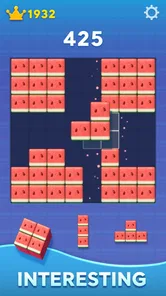
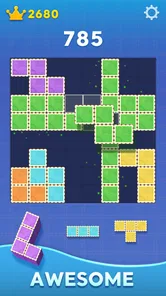
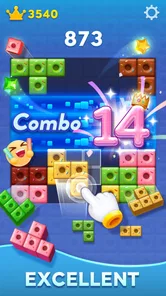
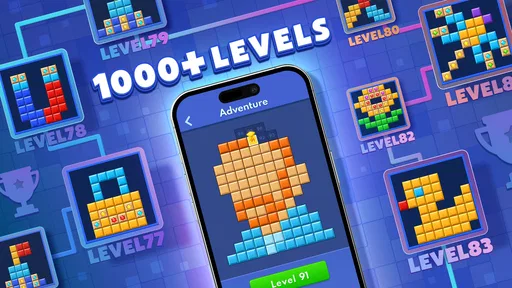
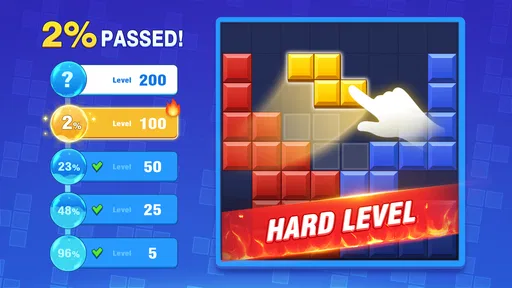
Block Blast! review
 Analysis by Gamesive
I like puzzle games that make me think without asking me to learn a long rulebook, and Block Blast! gets to the point quickly. I place a shape on the board, watch the rows or columns clear when I complete them, and then decide where the next pieces should go. That simple action-and-response loop is the game’s real appeal: each move changes the space I have left, so even a short round can turn into a small planning challenge.
Placing the first pieces
Block Blast! is a free puzzle game from HungryStudio, built around fitting block shapes onto a board and clearing completed lines. The opening is easy to understand: choose one of the available shapes, place it where it fits, and keep the board usable for the pieces that follow. I didn’t need a tutorial-heavy introduction to see what the game wanted from me, which makes it comfortable to open during a spare moment.
The basic rules are straightforward, but the decisions are not always trivial. A piece that fits neatly now can leave an awkward pocket that is hard to fill later. I get better results when I look at all the shapes currently offered before placing any of them, rather than grabbing the first one that seems convenient. That quick scan is a useful habit: it helps me notice whether a larger piece needs to go down before the board gets cramped.
This is a good fit for people who enjoy spatial puzzles but don’t want a story, a lengthy setup, or a complicated control scheme. It also works for casual players who want something they can understand in seconds. The trade-off is that anyone looking for character progression, a campaign, or a puzzle with a single carefully authored solution may find the repeating board-and-block format too narrow.
The game carries an Everyone age rating, so its premise is accessible to a broad range of players. That doesn’t mean every decision is effortless: keeping a board open takes attention, and a careless placement can make the next few turns much harder. I think that balance is part of the appeal. The rules stay light while the player supplies the challenge.
Why the board becomes a planning problem
The satisfying part is not simply finding an empty patch. I have to think about the shape of the spaces I’m leaving behind. A long, narrow gap may be manageable if I still have room for a matching block, but it can become a dead end when the available pieces are bulky or irregular. In practice, I try to preserve a broad, flexible area instead of filling every corner just because it is open.
That approach also explains why clearing a line can be more valuable than placing a piece in the most visually tidy spot. A placement that completes a row or column gives back space and can make several later options possible. When I’m deciding between a move that clears immediately and one that keeps a useful area open, I weigh both: a quick clear feels rewarding, but preserving room can be the safer choice when the board is already crowded.
The rhythm of a move
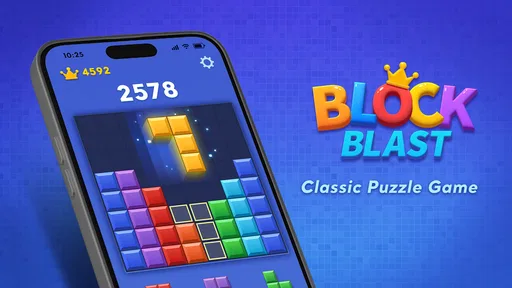
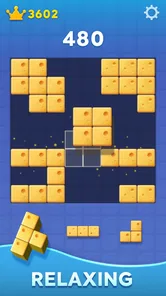
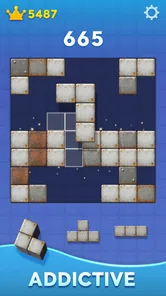
Each placement gives immediate visual feedback: the shape occupies the board, and completed lines disappear. That makes it easy to follow the consequences of a choice without interrupting the puzzle to read instructions. The pace is self-directed. I can take a moment to inspect the board, or move more quickly when the layout is obvious.
The strongest moments come when one placement clears more than I expected or opens up a section that looked nearly unusable. Those turns feel like earned relief rather than a complicated reward system. The game’s feedback is in the board itself: space opens, the next move becomes clearer, and I get another chance to keep the layout under control.
There is a flip side. When the board is nearly full, a run of pieces that don’t fit can make the end feel abrupt. I don’t see that as a flaw in the rules so much as the consequence of the game’s central tension: the board is the resource, and poor space management spends it. If I want a very forgiving puzzle where a mistake can be undone or ignored, this may feel harsher than expected.
Small wins and useful habits
The reward here is mostly the pleasure of solving the current arrangement and extending a run before the board closes in. That gives the game a nice balance between relaxed play and focused thinking. I can enjoy a satisfying clear without needing a large prize or a lengthy progression track to make the move matter.
One practical tip is to treat the available shapes as a set, not as three unrelated turns. Before placing anything, I check which one is hardest to accommodate and reserve a suitable area for it. This is especially useful when a long block or a wide shape is waiting. It may mean choosing a less satisfying move first, but it can prevent the board from becoming boxed in.
Another useful habit is to avoid building isolated holes. A single empty square surrounded by occupied blocks can be harder to use than a larger open patch, because future pieces have to match its shape. I try to clear lines in a way that joins spare spaces together where possible. It’s a small adjustment, but it changes the puzzle from “Where can this piece fit?” to “What kind of board am I creating for the next pieces?”
For a quick everyday session, I can see it working during a commute, while waiting for food, or in a quiet break between tasks. The board gives me something concrete to focus on, but the rules are simple enough that I can stop thinking about the game as soon as I put it down. The store summary highlights offline play, which is useful when a connection is unavailable; I’d still treat the core attraction as the puzzle itself rather than expecting online competition or social features.
When a round ends, and why I start again
A round ends when the remaining space no longer accommodates the pieces I need to place. That reset is central to the game’s rhythm. I can look back at the board and usually identify a decision that contributed to the jam: a gap I left too small, a line I could have cleared earlier, or a piece I placed without considering the rest of the set. Then I’m tempted to try again with a slightly better plan.
This restart loop is satisfying if you enjoy improving through small adjustments. It is less appealing if losing a run frustrates you or if you want every session to deliver a clearly different scenario. The core activity remains consistent, so the fresh challenge comes from the changing arrangement of pieces and the choices I make, not from switching into a new genre or following a dramatic plot.
That consistency makes it easy to pick up, but it can also become repetitive. I recommend taking a break when I notice I’m placing shapes automatically rather than thinking about the board. The game is most enjoyable when I’m making deliberate choices; playing on autopilot can turn the same clean feedback into a routine.
How it compares with other puzzle games
Compared with word puzzles, number grids, or match-style games, this is more directly about spatial fit and preserving room. There’s no need to search for a word or calculate a sequence of numbers; I’m judging shapes, gaps, and possible line clears. That makes it a better choice when I want a visual puzzle with quick turns, while a crossword or logic grid may suit me more when I want clues, a longer chain of reasoning, or a more defined solution.
It also differs from puzzle games that rely on a sequence of handcrafted levels. Here, the appeal is the repeated challenge of managing the board and adapting to the shapes I’m given. Players who like setting a personal target and trying to improve their own decisions may enjoy that open-ended loop. Those who want a new environment, fresh mechanics, or a clear sense of chapter-by-chapter progress should look elsewhere.
Practical details before you play
The game has been available since September 23, 2022, and its current version is 10.8.9. It requires Android 7.1 or later. Block Blast! has an average rating of 4.8 from around 5.8 million ratings, with about 78,000 written reviews, and it has passed one billion installs. Those figures suggest that its simple, repeatable format has found a very large audience, though popularity alone won’t make the puzzle style right for everyone.
It is free to download, with in-app purchases ranging from $4.99 to $49.99 per item. I’d keep that in mind if you prefer games with no paid options at all. The basic idea is easy to assess before spending anything: play a few rounds and see whether managing space feels pleasantly absorbing or repetitive. I wouldn’t treat optional purchases as necessary to understand the core puzzle.
My verdict on the loop
I recommend Block Blast! to anyone who wants a compact spatial puzzle with immediate feedback, quick entry, and a satisfying reason to reset after a crowded board. Its best quality is how much planning it draws from a small set of rules. Looking ahead at the pieces, protecting flexible space, and avoiding tiny isolated gaps can make an ordinary placement feel thoughtful.
I’d skip it if I needed a story, carefully staged level variety, or a forgiving system that shields me from the consequences of a poor move. I’d also choose another puzzle genre if I wanted wordplay or number logic rather than shape placement. But when I have a few spare minutes and want a clear, self-contained challenge, the cycle of placing, clearing, running short on room, and trying again is easy to return to. The most useful way to play is to plan for the whole set of pieces, not just the one in your hand.
What we like
- Easy-to-learn controls make it welcoming for new players.
- Short rounds suit quick breaks throughout the day.
- No internet connection is needed for basic play.
- Block placement rewards planning and spatial reasoning.
- The clean board keeps pieces easy to distinguish.
What could be better
- There is no undo option for correcting a placement.
- A single full row or column may not clear the board.
- Later rounds can feel demanding when space is limited.
- Random piece options can disrupt a carefully planned strategy.
- Frequent play may feel repetitive without varied objectives.
Frequently Asked Questions
What kind of game is Block Blast!?
Block Blast! is a casual block puzzle game built around fitting differently shaped pieces into a grid. You place each offered piece on the board, aiming to complete full rows or columns so they clear and make room for more blocks. There is no falling-piece timer in the standard puzzle mode, so you can take time to plan each move. The game ends when none of the available pieces can fit.
Can I play Block Blast! offline?
The core puzzle experience is generally designed for quick play and may be available without an active internet connection, which makes it convenient for travel or short breaks. However, online access may be needed for features such as advertisements, rewarded video offers, events, leaderboards, or syncing certain progress. Availability can vary by version and device, so check the game after installation if offline play is important to you.
Is Block Blast! free to download and play?
Block Blast! is typically free to download, and its basic block-puzzle gameplay does not require an upfront purchase. The free experience may include advertisements, and the game can offer optional rewards or other features connected to viewing ads. Store listings and monetization can change over time or differ by region, so review the current Google Play or App Store details before downloading if you want to know about in-app purchases or other costs.
Does Block Blast! have levels, a time limit, or an ending?
Block Blast! is mainly focused on achieving a high score rather than completing a fixed sequence of levels or reaching a story ending. In its usual classic-style mode, you place pieces at your own pace, with the goal of clearing rows and columns and keeping the board open. Some versions may include additional modes or limited-time events, and their rules can differ, so check the in-game mode descriptions for current details.
Is Block Blast! suitable for children, and what should parents check?
The rules are simple to understand, and the game does not rely on complex controls, which can make it approachable for a wide range of ages. Still, parents should review the age rating and privacy information on the relevant app store, as well as the current version’s advertising, in-app purchase, and data practices. If a child uses the game, parental controls can help manage purchases, screen time, and exposure to ads.
Permissions
On Android, Block Blast! asks for these permissions.
- Photos/Media/Files
- read the contents of your USB storage, modify or delete the contents of your USB storage
- Storage
- read the contents of your USB storage, modify or delete the contents of your USB storage
- Wi-Fi connection information
- view Wi-Fi connections
- Other
- view network connections, full network access, reorder running apps, control vibration, prevent device from sleeping
Languages
Block Blast! is also available in 2 other languages on our site.
User reviews
4.8 out of 5
5,759,470 reviews
- 93%
- 4%
- 1%
- 1%
- 2%
Download Block Blast!
Puzzle · HungryStudio · Free
Games like Block Blast!
View all: Games like Block Blast!
Gossip Harbor: Merge & Story
Puzzle4.4 out of 5

Magic Sort!
Puzzle4.6 out of 5
Rotate Rings
Puzzle4.8 out of 5
Meowdoku: Brain Puzzle Games
Puzzle4.7 out of 5
Word Tiles - Relaxing Puzzle
Puzzle4.9 out of 5
About this listing
- Game
- Block Blast!
- Developer
- HungryStudio
- Package
- com.block.juggle
- Version reviewed
- 10.8.9
Gamesive reviews games on its own and is not paid by developers for scores. We do not host game files: the download buttons open the official Google Play and App Store pages. Names, icons and screenshots belong to their owners.