Color Block: Combo Blast
Puzzle4.3 out of 5
For Android & iOS · Guru Puzzle Game
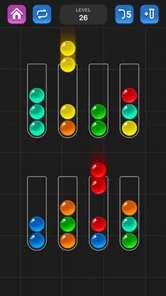
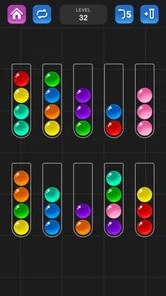
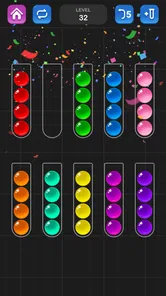
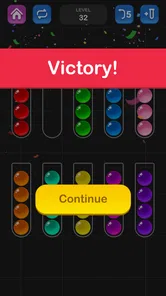
 Analysis by Gamesive
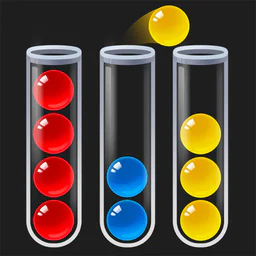
I like puzzle games that give me something to think about without demanding a long, uninterrupted session, and Ball Sort Puzzle - Color Game fits that kind of break well. Its central idea is simple: move colored balls between tubes until each tube contains just one color. The challenge is not the tapping; it is deciding which move will leave enough room for the colors still mixed together. I find that small planning problem satisfying, especially when a puzzle looks stuck and one careful rearrangement opens up several options.
This is a color-sorting puzzle game from Guru Puzzle Game, built around one clear ability: seeing how a move changes the space available for everything else. You are not matching colors on a board or racing a timer. You are organizing a limited set of containers, and every transfer can help or make the next few moves harder.
That focus is the game’s strongest quality. The rules are easy to grasp, so I can start playing without a tutorial-heavy learning curve. Yet a board with several partly filled tubes asks for more than reflexes. I have to notice which color is blocking another, keep an empty tube available when possible, and avoid filling a useful space with a color that will soon need to move again.
The result is a gentle but meaningful kind of concentration. A level can feel almost trivial when the colors are already grouped, then become a small logic exercise when a tube contains a sequence that must be untangled. I enjoy that change in pace: the game stays approachable, while the sorting itself supplies the difficulty.
In practice, I treat an empty tube as working space rather than as a spare container to fill at the first opportunity. Moving a color into it may seem productive, but keeping that space open can give me room to separate a mixed tube later. This is one of the most useful habits I have picked up: before tapping, I check whether the move preserves a place to temporarily park a color.
I also look beyond the color I am trying to complete. If I move a ball that exposes a different color underneath, that may be more valuable than immediately making one tube look tidier. The best move is often the one that reveals options, not the one that produces the most visible progress. That distinction is what makes the game feel like a puzzle rather than a simple sorting task.
When I get into a dead end, I pause and mentally trace the blocked colors instead of making several hopeful moves. A partly sorted tube can be useful because it keeps matching balls together, but it can also become a bottleneck if the color beneath it is needed elsewhere. Reconsidering the order of transfers is usually more helpful than repeatedly tapping at random.
My practical tip is to protect flexibility before chasing a finished tube. Completing one color feels rewarding, but if it consumes the only space that could separate two other colors, the board may become harder to manage. I try to make moves that preserve at least one route through the remaining mix, especially when several tubes are partly filled.
The game works particularly well in short pauses: waiting for a kettle, taking a quiet moment between tasks, or settling in for a few minutes before bed. I can focus on one board, put the phone aside, and return to the basic logic without needing to remember a story or a complex control scheme. That makes it easy to pick up when I want a small mental reset rather than a full gaming session.
It is also useful when I want a puzzle that does not depend on a rapid response. The central challenge is planning, so I can take my time considering a transfer. That makes it a better fit for a calm break than a fast arcade game, though anyone looking for constant action may find the deliberate pace too quiet.
The game can be played offline, which makes it convenient when I am somewhere with an unreliable connection or simply want a casual activity without needing to stay online. I would not treat that as a reason to expect a deep campaign or a changing social experience; the appeal is the repeatable act of untangling colors at my own pace.
For a realistic everyday routine, I would use it as a brief pause after finishing a work task, rather than as something to keep open all afternoon. A single puzzle gives my attention a clear target, and stopping afterward feels natural. If I know I tend to lose track of time in casual games, setting my own stopping point before opening it is a sensible way to keep the break short.
Compared with match-three puzzles, this game asks me to think about order and capacity rather than scanning for combinations. There is no board full of possible matches to evaluate; the key question is where a color can go without trapping another one. I prefer that focused problem when I want a clean logic challenge, while match-three games are a better choice when I want more visual activity and a faster rhythm.
It also differs from Sudoku and other number-based logic puzzles. Those ask me to track rules across a grid, whereas this one makes the consequences of a move visible in the tubes. That visual feedback can make the puzzle easier to approach, but it does not remove the need to plan. If you enjoy abstract reasoning but dislike working with numbers, the color-based format may feel more inviting.
On the other hand, a dedicated logic-puzzle collection may be a better pick if you want varied mechanics and a sequence of different problem types. Ball sorting is intentionally narrow. Its strength is that I can learn the central challenge quickly and return to it, not that it constantly reinvents how I play.
The same focus that makes the game easy to understand can also limit its appeal. Once I have spent a while sorting tubes, the basic decision pattern remains familiar: make space, expose colors, and avoid blocking useful moves. Players who need a strong narrative, distinct modes, or a wide rotation of mechanics may find that repetition more noticeable than the relaxing rhythm.
There is also a small but real tension between moving quickly and thinking carefully. Because the controls are straightforward, it is tempting to tap through a plan before checking the consequences. A careless move can leave a board less flexible, and that can turn a soothing puzzle into a frustrating one. I recommend slowing down when several colors are interleaved rather than assuming every available transfer is helpful.
It is free to download, with in-app purchases listed at $7.99 per item. That matters if you prefer games with no optional spending at all: the purchase option is worth knowing about before you install, even if the core sorting idea is what draws you in. I would make a deliberate choice about any purchase rather than treating it as necessary to enjoy the puzzle.
The game is rated Everyone, which makes its straightforward, nonviolent puzzle format suitable for a broad audience. Still, “easy to understand” does not mean every board will feel easy. Younger players or anyone new to this style may need patience to see why a move that looks useful can close off a route later.
I would recommend Ball Sort Puzzle - Color Game to someone who likes quiet, visual logic challenges and wants to play in short bursts. It is especially well suited to people who enjoy noticing patterns, working through a small obstacle, and getting a clear sense of progress from organizing a messy board. The game’s 4.9 average rating from around 1 million ratings, alongside over 50 million installs, suggests that this simple premise has found a large audience.
It is less suited to players who want competitive pressure, a rich story, or a steady stream of new gameplay systems. If your favorite puzzles depend on racing a clock or competing with other people, this may feel too solitary and measured. If you tend to dislike repeating a single central mechanic, a broader puzzle collection will probably hold your attention longer.
For me, the best reason to keep it installed is the way it turns a tiny everyday pause into a focused exercise. I do not need to learn a complicated system, and I can play offline when that is more convenient. The game was released on May 18, 2022, and its current version is 5.9.0, with Android 7.0 as the minimum operating-system requirement.
My overall impression is that this is a dependable choice when I want to slow down and think through a compact problem. It is not the right game for every mood, and its narrow focus can become repetitive, but the sorting mechanic is satisfying when I approach it patiently. If you enjoy arranging colors, preserving room for a clever next move, and finishing a puzzle at your own pace, I think it is well worth trying.
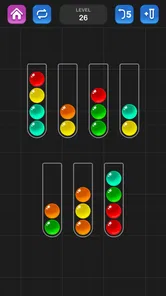
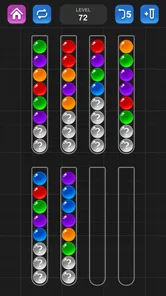
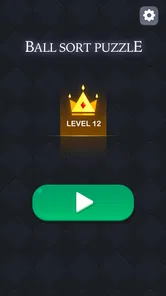
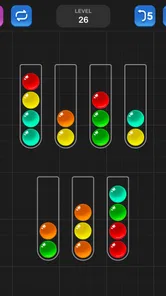
The goal is to sort the colored balls so that each tube holds balls of just one color. Tap a tube to lift its top ball, then tap another tube to move it there. You can usually place a ball only on an empty tube or on a ball of the same color, and each tube has limited space. Plan moves carefully, since a level can become difficult if you fill the available tubes too quickly.
Ball Sort Puzzle - Color Game is generally designed as a casual, single-player puzzle, so its core sorting levels may be playable without an internet connection. However, features such as ads, optional rewards, store content, or progress syncing can depend on connectivity and may vary by version. If offline play matters to you, check the app’s current store listing and test a level with your device disconnected, especially after installing an update.
The game is commonly offered as a free download, but the exact business model can vary by platform, region, or release. Free versions of casual puzzle games may show advertisements between levels or offer optional purchases, such as hints or ways to remove ads. Review the Google Play or App Store listing for current pricing and purchase details, and check the in-game settings before buying anything.
If a puzzle seems stuck, pause before making another move and look for colors that are blocking balls needed elsewhere. Empty tubes are especially useful because they provide temporary space, so try to keep at least one available when possible. Depending on the version, the game may also provide an undo, restart, or hint option. These tools can help, though restarting a level may be the simplest choice if several tubes are already crowded.
The sorting mechanic is simple to understand and does not require reading-heavy gameplay, which can make it approachable for many ages. Still, suitability depends on the particular version, including its ads, optional purchases, and age rating. Before downloading, review the rating and privacy information on your device’s app store, and check the permissions requested by the installed app. For a child’s device, consider using parental controls to manage purchases and screen time.
On Android, Ball Sort Puzzle - Color Game asks for these permissions.
Ball Sort Puzzle - Color Game is also available in 1 other languages on our site.
4.9 out of 5
1,016,791 reviews
Puzzle · Guru Puzzle Game
Puzzle4.8 out of 5
Puzzle4.9 out of 5

Puzzle4.7 out of 5

Puzzle4.8 out of 5

Puzzle4.8 out of 5

Puzzle4.9 out of 5
Card4.9 out of 5

Puzzle4.9 out of 5
Puzzle4.3 out of 5

Puzzle4.4 out of 5

Puzzle4.7 out of 5

Puzzle4.8 out of 5
Puzzle4.8 out of 5

Puzzle4.1 out of 5
Puzzle4.9 out of 5

Puzzle4.9 out of 5
Puzzle4.8 out of 5

Puzzle4.9 out of 5

Puzzle4.9 out of 5
Puzzle4.9 out of 5



Gamesive reviews games on its own and is not paid by developers for scores. We do not host game files: the download buttons open the official Google Play and App Store pages. Names, icons and screenshots belong to their owners.