Offline Games - No Wifi Games
Casual4.6 out of 5
For Android & iOS · King
 Analysis by Gamesive
The first thing I notice about Candy Crush Saga is how quickly it turns a spare minute into a small puzzle session. I can look at a board, spot a few possible matches, and decide whether I have time for one more attempt. Its bright candy pieces and clear match-three rules make the opening easy to understand, but the appeal is not only novelty: the changing board layouts ask me to adjust my plans rather than repeat one fixed move.
King’s casual game is free to start, rated for Everyone, and available on Android devices running version 7.0 or later. It has a 4.6 average from around 39 million ratings, and more than a billion installs. That scale makes sense for a game built around short, familiar sessions, though popularity alone does not tell me whether it will suit your routine. The more useful question is whether its puzzle rhythm stays enjoyable once the first burst of curiosity passes.
The basic loop takes very little explanation: match candies, work toward the board’s objective, and try again when a level does not go your way. The simplicity is a strength when I want a game that does not demand a long tutorial or a quiet hour to learn its controls. It also makes the game easy to hand to someone who has not played many mobile puzzles.
What gives the early levels their pull is the way a familiar rule can produce different decisions. A match that looks attractive may not help with the objective in front of me, while a less obvious move can open space for a more useful combination. I get the most satisfaction when I pause for a moment and plan around the board instead of tapping the first match I see. That small shift makes the game feel more thoughtful than its candy-coated presentation suggests.
It fits naturally into everyday gaps. I might open it while waiting for a kettle to boil or during a short break, complete a level, then put my phone away. Because each attempt is compact, I do not need to reserve a block of time or remember a complicated story. If you want a game for a commute or waiting room, though, bear in mind that a level that proves stubborn can turn a quick visit into repeated retries.
One practical tip is to look at the level’s objective before making the first move. It helps me avoid spending early turns on matches that look satisfying but do little to advance the task. I also try to scan the lower part of the board before moving candies near the top: changes below can affect what falls into place afterward. These habits do not guarantee a win, but they make my choices feel less random.
The best moments come from balancing immediate progress against what the board may look like after a move. Clearing a tempting group can be less useful than keeping a route open for a later match. That trade-off gives the game a modest planning layer without making it feel like a serious strategy title. I can play casually, but paying attention usually makes a level feel more manageable.
There is also a useful difference between playing to relax and playing to clear a particular level. When I am in a relaxed mood, I enjoy following the board and seeing what combinations emerge. When I am focused on an objective, I slow down and prioritize the pieces or spaces that matter. If you prefer games where every move has a transparent, fully controllable outcome, the shifting possibilities of a match-three board may feel too dependent on chance.
Over several weeks, Candy Crush Saga’s value depends less on its colorful first impression and more on whether you like returning to bite-sized puzzles. It is not a game I would recommend as a deep narrative or a demanding competitive challenge. Its strength is dependable accessibility: I can return after a break and understand what I am doing immediately. That makes it easy to keep installed even when I do not play every day.
Compared with many casual puzzle games, its familiar match-three format is both its advantage and its limitation. The rules are easier to pick up than those of games built around elaborate systems, but the central activity can feel repetitive if you want each session to introduce a completely different kind of play. I would choose it over a more involved puzzle game when I have only a few minutes; I would choose a richer tactics or story-driven game when I want a longer, more varied experience.
A useful way to keep it from becoming a chore is to treat a difficult level as a stopping point rather than a dare. If I have tried several times and stopped enjoying the puzzle, closing the game preserves its role as a casual break. Returning later with fresh attention is often more pleasant than extending a session just to force progress. This is especially helpful for players who tend to turn small mobile games into daily obligations.
The game is free to download, with in-app purchases ranging from $0.99 to $149.99 per item. That range is worth keeping in mind if you are sensitive to spending prompts or prefer games with a single upfront cost. I would decide in advance whether I am comfortable making optional purchases, and avoid treating a difficult level as a reason to spend. The game works best for me when I enjoy the puzzle itself, not when I feel pressured to pay to make a session satisfying.
There is little maintenance in the ordinary sense: I do not need to manage a complex roster, learn a rotating set of controls, or rebuild my skills after a short absence. The current version is 1.341.2.1, but the core appeal remains the simple act of reading a board and choosing a match. If you are deciding whether to keep it on your phone, ask whether you genuinely enjoy that repeated decision-making. If you mainly installed it because everyone seems to know it, familiarity may not be enough to hold your attention.
For a parent considering a casual game for a child, the Everyone age rating is reassuring as a broad content classification, but I would still consider the child’s ability to handle optional purchases and screen-time boundaries. The game’s accessible presentation can make it easy to continue from one short session into another. I would set expectations around when to stop rather than relying on the game’s simple appearance to make that decision for a younger player.
Another good use case is a shared recommendation between people with different gaming experience. One person can explain the match-three idea in moments, and both can compare how they approach a tricky board without needing specialist knowledge. On the other hand, it is not ideal if you want a cooperative activity in which players build something together; the appeal here is individual problem-solving, not a shared campaign.
The main source of fatigue is repetition. Even when layouts and objectives change, I am still matching candies, reading a grid, and trying to make progress through a level. If that core loop is satisfying to you, small variations can be enough to sustain regular play. If you tire quickly of repeating a basic interaction, the bright visuals will not solve that problem for long.
Difficulty can also interrupt the relaxed mood the game initially invites. A level that does not yield to a few sensible attempts may make me feel stuck, especially if I opened the app only for a quick distraction. I find it helps to separate “I want a short puzzle” from “I want to finish this exact level.” The first goal is easy to meet; the second can keep me playing longer than I intended.
Compared with a minimal offline-style puzzle, Candy Crush Saga has a more persistent sense of progression and a broader, long-running identity. That can make it feel more substantial than a collection of identical standalone boards. But if you want to avoid purchase options altogether, or you dislike games that encourage repeated attempts at a level, a simpler puzzle app may fit you better. The right choice depends on whether progression motivates you or feels like pressure.
I would keep Candy Crush Saga installed if I wanted an easy, familiar puzzle for brief breaks and enjoyed thinking a move or two ahead. It is particularly suited to people who like visible goals, quick retries, and a game they can resume without relearning its basics. King has made a casual format that is approachable without being entirely mindless, provided I take a moment to plan instead of tapping at random.
I would skip it if I were looking for a substantial story, a highly varied set of mechanics, or a game that never nudges me toward optional spending. The large number of players and strong average rating show how broadly it has landed, but they do not make its repeated match-three loop universal. For me, its lasting value comes from keeping sessions short and treating progress as a bonus rather than a duty.
Overall, I recommend it as a low-friction choice for people who genuinely enjoy candy-board puzzles, with one condition: be honest about whether the loop still feels fun after the first week. If it remains a pleasant way to fill a small gap, it earns space on your phone. If you start opening it out of habit and leaving annoyed, there is no reason to force the routine. The game is at its best when it stays a light break, not another task on your day.
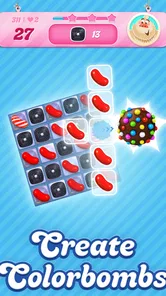
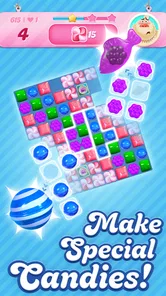
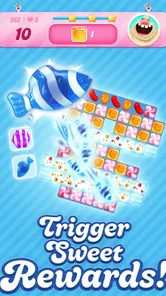
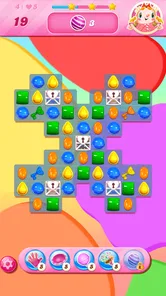
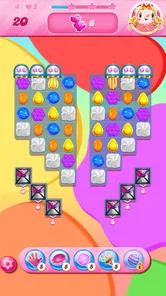
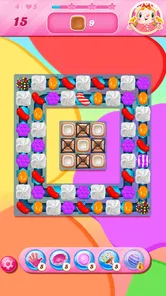
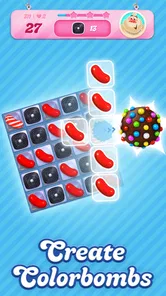
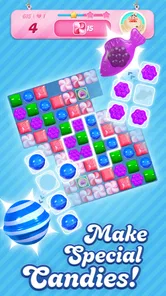
Candy Crush Saga is a colorful match-three puzzle game in which you swap adjacent candies to line up three or more of the same kind. Matching candies clears them from the board and may create special candies that remove rows, columns, or larger groups. Each level has its own objective, such as collecting ingredients or reaching a target score, and a limited number of moves to complete it.
Candy Crush Saga is free to download, and you can play many levels without paying. The game also offers optional in-app purchases, including items that can provide extra moves, lives, or other advantages. You do not have to buy these to start playing, but purchases can make it easier to progress through difficult stages. Check the app store listing and your device’s purchase settings for current pricing and payment controls.
You can generally play previously downloaded levels without an internet connection, which can be handy when traveling or away from Wi-Fi. However, some features may require connectivity, including syncing progress across devices, accessing certain events, and using social or promotional functions. Availability can vary by version and device, so it is best to open the game while connected before going offline and avoid uninstalling it if your progress has not been synced.
Candy Crush Saga uses a lives system, so failing a level can cost a life, and you may need to wait for lives to refill or use an available in-game option. The game may also display promotional content or offers, while optional purchases can provide boosters or additional help. These systems can affect how quickly you progress, but you can still attempt levels without buying items; the exact offers and rules may change with updates.
The game can sync progress when you connect it through a supported account or sign-in option, allowing you to continue on another compatible device. Make sure the game shows that your progress is connected before switching devices or reinstalling the app, and use the same account on both. Sync features and account options may change over time, so check the current in-game settings and the official app-store information if you need help restoring a saved game.
On Android, Candy Crush Saga asks for these permissions.
Candy Crush Saga is also available in 2 other languages on our site.
4.6 out of 5
38,885,826 reviews
Casual · King

Casual4.2 out of 5
Casual4.3 out of 5

Casual4.8 out of 5

Casual4.6 out of 5
Casual4.7 out of 5
Casual4.7 out of 5
Casual4.6 out of 5
Casual4.6 out of 5

Casual4.2 out of 5

Casual3.2 out of 5
Casual4.7 out of 5

Casual4.7 out of 5
Casual4.3 out of 5

Casual4.7 out of 5
Casual4.5 out of 5
Casual4.8 out of 5

Casual4.6 out of 5

Casual4.9 out of 5

Casual4.7 out of 5



Gamesive reviews games on its own and is not paid by developers for scores. We do not host game files: the download buttons open the official Google Play and App Store pages. Names, icons and screenshots belong to their owners.