
Offline Games No WiFi internet
Casual4.7 out of 5
For Android & iOS · Azur Interactive Games Limited
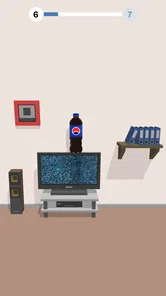
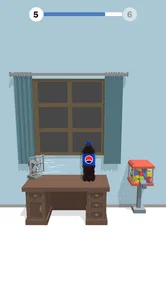
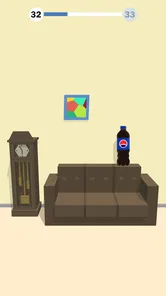
 Analysis by Gamesive
Bottle Flip 3D is best understood as a small test of timing, not a physics playground or a deep puzzle game. I find its appeal in the simple promise of each attempt: tap, send a bottle into the air, and try to land it safely on the next surface. That makes it easy to pick up when I have a few spare minutes, while the need to judge each jump gives the game more focus than its premise suggests. It is a casual game from Azur Interactive Games Limited, and its strengths are immediate access and a clear, repeatable challenge. Its limitation is the same simplicity: if you want a long-term game built around story, strategy, or broad variety, this is unlikely to hold your attention for long.
The central action is easy to grasp. I tap to make a bottle flip, then watch where it comes down and decide whether the next move is worth attempting. There is no complicated control scheme to learn before I can play, which makes it a natural choice for a short break or for handing to someone who has not played it before. The game’s appeal comes from turning a tiny action into a moment of concentration: a jump can look straightforward, but a careless tap can end a run.
That compact loop gives each attempt a useful rhythm. I focus on the immediate landing rather than managing a character, building a collection, or tracking several objectives at once. When a jump succeeds, the next one becomes a fresh little decision. When it fails, I can understand what went wrong and try again without having to work through a complicated setup. The skill is in pacing the taps, not tapping as fast as possible. That distinction is what keeps the game from feeling like a button-mashing test.
The name is descriptive, but the experience is more about reading a sequence of landing opportunities than simply making a bottle jump once. I would approach it with patience: watch the space ahead, allow the bottle’s movement to resolve, and make the next input deliberately. That is a more useful mindset than trying to force progress through rapid taps. The game is at its best when I treat each landing as a small timing problem instead of expecting every attempt to work on instinct.
In the casual-game field, this sits closer to a quick reflex challenge than to an endless runner or a logic puzzle. An endless runner generally asks me to react continuously as the scenery advances; a puzzle game gives me time to plan around rules and multiple pieces. Bottle Flip 3D narrows the decision to a single, readable action, so it suits players who want a brief concentration break without committing to a long session. That focus is a strength, though it also means there is less room for players who need changing mechanics to stay engaged.
I can see this working well in ordinary pockets of downtime: waiting for someone, taking a short break between tasks, or passing a phone around while friends compare attempts. It does not demand that I remember a story or return at a particular time to keep up with anything. A quick session can be satisfying on its own, especially if I am in the mood to improve my timing rather than explore a large game world.
There is also a practical way to make repeated attempts less frustrating. Instead of treating every failed jump as a reason to tap sooner, I would pause for a moment and notice whether I misjudged the timing or rushed the input. That small reset helps keep the challenge from turning into automatic repetition. It also gives the game a modest learning curve: improvement comes from paying attention to the same basic action, not from memorizing a complicated control layout.
The game’s narrow focus can become repetitive. Once the basic action is familiar, the same kind of timing decision may not be enough for players who want a steady stream of new ideas. I would not recommend it as a substitute for a deeper casual game if your enjoyment depends on varied objectives, elaborate progression, or a strong sense of discovery. The concise design is convenient, but it can leave a longer session feeling like more of the same.
It also asks for a particular kind of patience. A player who expects every tap to produce a predictable result may find the trial-and-error rhythm irritating, especially after a few missed landings. I think it works better when I am content to make another attempt and adjust my timing than when I am trying to finish something quickly. If a game needs to offer a broad range of activities to hold your interest, this one is probably not the right pick.
Another trade-off is that the game’s simplicity makes it less suited to players looking for a relaxing experience with little pressure. Although the controls are straightforward, the focus on landing can make a small mistake feel decisive. I would choose a calmer, less timing-centered casual game if I wanted background play while distracted. Here, paying attention is part of the point; splitting focus can make the challenge less enjoyable rather than more convenient.
I would suggest it to someone who enjoys quick, repeatable tests of timing and wants a game that can be understood in moments. It is especially suitable for casual players who prefer one clear action over menus and complex systems. Families can also find the premise easy to explain to younger players, although an Everyone content rating is not a guarantee that every child will enjoy repeated failures. The best fit is someone who likes trying again and can take a missed landing lightly.
By contrast, I would steer a completion-focused player toward a game with more varied goals, and a strategy-minded player toward something that rewards planning across several moves. If you mainly want a colorful distraction that requires no attention, this may ask more focus than you expect. The useful question is not whether bottle flipping sounds fun in the abstract, but whether repeating a small timing challenge is satisfying for you. If the answer is yes, its compact format is a real advantage.
The game is free to download, with in-app purchases ranging from $0.99 to $9.99 per item. I would treat those as optional spending rather than a reason to start playing: the core idea is easy to understand without buying anything. If you are considering a purchase, check what it offers in the app before committing and decide whether it addresses something you actually want. That is sensible for any free game with optional paid items, particularly one whose appeal comes from a very simple play loop.
On the app-store scale, Bottle Flip 3D has an average rating of 4.2 from around 433,000 ratings, alongside roughly 9,800 written reviews and over 100 million installs. Those figures suggest that its straightforward premise has reached a large audience, but popularity does not make the short-loop design a match for everyone. I would read its appeal as broad accessibility rather than depth: lots of people can understand the game quickly, while whether they stay depends on how much they enjoy repeating the same kind of challenge.
It was released on April 23, 2019, and the current version is 1.12.0. It requires Android 7.1 or later, and its age rating is Everyone. Those details make it easier to judge basic suitability before downloading, especially if you are checking compatibility on an older Android device. Since it is a casual game, I would still think about the way it will be used: a short, focused session suits it better than expecting a substantial game to fill an entire evening.
One non-obvious benefit of this kind of narrow control scheme is that it makes informal play easy to compare. Two people can take turns and judge success using the same simple action, without needing to learn separate characters or strategies first. The trade-off is that this is only appealing if both enjoy repeating attempts; it is not a guarantee of lively group play. For a quick pass-around challenge, I would suggest agreeing to take turns rather than having everyone tap at once, so the timing remains the focus.
I would also recommend setting expectations before opening it. Think of it as a small game for brief bursts, not as a campaign that promises hours of changing content. If it clicks, keep sessions short enough that each attempt remains engaging; if the loop begins to feel repetitive, there is little reason to push through just because the controls are easy. That is a useful way to judge this particular game: its simplicity should make starting effortless, not obligate you to keep playing.
Bottle Flip 3D succeeds as a focused casual game because it turns one simple input into a clear timing challenge. I like how quickly it gets to the point, how easily I can fit a few attempts into an idle moment, and how a little patience is more valuable than frantic tapping. At the same time, the limited core loop is a genuine constraint, not a flaw that can be ignored: players who want sustained variety, layered progression, or a low-attention pastime will probably be happier elsewhere.
My recommendation is specific. Try it if you enjoy short challenges where each attempt gives you a chance to adjust your timing, and if repeating a basic action sounds satisfying rather than monotonous. Skip it if you need a story, many kinds of objectives, or a longer-term goal to keep you invested. For the right player, this is an easy game to pick up and a neat way to occupy a small break; for everyone else, its central idea may run out of room before they do.
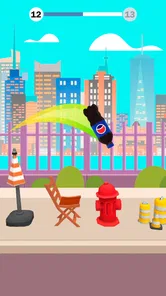
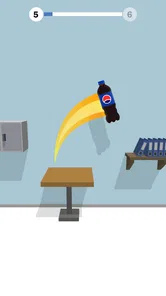
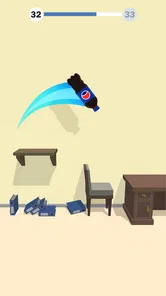
Bottle Flip 3D — Tap & Jump! is an arcade-style game built around a simple action: tap to make a bottle flip through the air and land on platforms. You guide it across rooms filled with furniture and other obstacles, aiming to reach the finish without falling. The controls are easy to understand, but judging when to tap and how far the bottle will travel takes practice.
The game is straightforward to start because its main control is tapping the screen, so there is little to learn before a first attempt. However, easy controls do not mean every level is easy: platforms vary in distance, and mistimed flips can send the bottle off course. Beginners can expect to retry sections while learning the timing. It is best suited to players comfortable with trial-and-error gameplay.
Basic level-based play may be available without a continuous internet connection, but availability can depend on the app version and the features you want to use. Online access may be needed for advertisements, optional rewards, events, or other connected content. If offline play matters to you, check the game’s current store listing and test it in airplane mode after installation rather than assuming every feature works without a connection.
The game may be offered as a free download, but free-to-play apps commonly support themselves with advertising and may also provide optional purchases. The exact ads, purchase options, and prices can change by platform, region, or update. Review the app’s Google Play or App Store listing before downloading, and check the purchase controls on your device if a child will be playing.
Its basic premise is simple and its presentation is generally aimed at casual play, which may make it accessible to younger players. Still, suitability depends on the current version: store listings can include ads, in-app purchases, or links to external content. Parents should review the age rating, privacy information, and permissions, and consider enabling device-level purchase restrictions before letting a child install or play.
On Android, Bottle Flip 3D — Tap & Jump! asks for these permissions.
Bottle Flip 3D — Tap & Jump! is also available in 2 other languages on our site.
4.2 out of 5
432,676 reviews
Casual · Azur Interactive Games Limited

Casual4.2 out of 5
Casual4.3 out of 5

Casual4.6 out of 5

Casual4.8 out of 5

Casual4.6 out of 5
Casual4.7 out of 5
Casual4.7 out of 5

Casual4.6 out of 5

Casual3.2 out of 5

Casual4.7 out of 5

Casual4.7 out of 5
Casual4.3 out of 5

Casual4.7 out of 5
Casual4.5 out of 5
Casual4.8 out of 5

Casual4.6 out of 5

Casual4.9 out of 5

Casual4.7 out of 5



Gamesive reviews games on its own and is not paid by developers for scores. We do not host game files: the download buttons open the official Google Play and App Store pages. Names, icons and screenshots belong to their owners.