Trivia Master - Word Quiz Game
Trivia4.5 out of 5

For Android & iOS · GeoGuessr

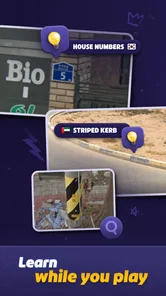
 Analysis by Gamesive
I enjoy trivia games most when they make me look closely at the world rather than simply recall a fact, and GeoGuessr has a satisfying way of turning observation into a quick puzzle. It places you in an unfamiliar real-world setting and asks you to work out where you are. That premise is easy to understand, but getting from a vague impression to a confident guess takes patience, pattern recognition, and a willingness to revise your first idea.
Developed by GeoGuessr, this free trivia game is a natural fit for anyone who likes maps, geography, and visual riddles. Its appeal is less about memorizing capitals and more about noticing clues: the look of a road, the landscape, signs, buildings, or the way a place is laid out. A good round can make an ordinary-looking scene feel full of information once you start asking the right questions.
My first useful habit is to avoid naming a country immediately. I look for broad clues first: climate, vegetation, terrain, and the general character of the built environment. Then I narrow the possibilities with smaller details such as language or road markings. This order helps prevent one familiar-looking sign or building from sending me in the wrong direction.
That approach also explains why the game can feel more thoughtful than a conventional multiple-choice quiz. Instead of retrieving a fact from memory, you build a case from what is visible. A guess can be plausible without being exact, and the challenge is to balance confidence against evidence. The most rewarding skill here is learning to notice which clues are reliable and which merely look familiar.
GeoGuessr can be played as a quick mental break, but it does not impose one ideal pace on every player. If I scan a scene casually and make a fast decision, a turn feels brisk. If I compare several details and reconsider a region, the same puzzle becomes a slower exercise in deduction. That flexibility is a strength, though players who want a rapid stream of obvious questions may find the visual reasoning less immediate.
There is also a small but meaningful difference between looking for a clue and looking for confirmation. If I decide too early that a scene belongs to one country, I tend to interpret every detail in its favor. A better routine is to identify two or three independent clues before settling on a guess. For example, I might combine landscape with road conventions rather than relying only on a language fragment. It makes the process more disciplined without turning a casual game into homework.
On a short break, I would use the game for a few rounds rather than expecting every session to be equally quick. Some scenes offer recognizable signs or distinct terrain; others require more careful comparison. That variation keeps the puzzle from becoming a rote quiz, but it also means the pace is partly in your hands and partly in the material you encounter.
The most demanding moments are not necessarily about speed. They come when a scene offers several competing possibilities, or when a player keeps inspecting details without finding a decisive clue. It is easy to spend too long trying to extract certainty from an ambiguous view. I recommend setting a personal stopping point: once you have a broad region and a couple of supporting clues, make your best call and learn from the result rather than endlessly second-guessing.
For a friendly group session, the game works well as a conversation starter. One person can point out a landscape feature while another notices a sign or road detail, and the disagreement becomes part of the fun. It is especially suited to people who enjoy explaining their reasoning, not just announcing an answer. By contrast, it may be a poor pick for a group that wants everyone to act at once or prefers a clearly scored, rapid-fire trivia format.
A practical way to improve without turning play into a study session is to keep a mental note of recurring patterns. If you repeatedly confuse two regions, ask what clue would distinguish them next time. The point is not to memorize every road sign in the world; it is to build a modest toolkit of observations. That makes later guesses feel earned and gives each mistake a useful takeaway.
I would judge reliability here by whether the core activity remains understandable and whether a player can return to the puzzle after a pause. The game’s basic loop is clear enough that it does not require a long explanation each time you open it. If you need to step away, the sensible expectation is to resume when convenient rather than rely on a round as a timed commitment. I would avoid starting a thoughtful session when I know I will be interrupted every few seconds, because the clues are easier to assess when I can keep the scene in mind.
As with any visually driven game, a momentary slowdown or interruption would matter more when I am in the middle of comparing details than during a simple fact question. I would not treat a single hiccup as evidence that the whole experience is unreliable; the important practical point is to give the game a stable connection and enough uninterrupted attention when possible. If a round does not seem to respond as expected, pausing briefly and reopening the game is a reasonable first troubleshooting step, rather than repeatedly tapping or making a rushed guess.
The title has an average rating of 3.8 from around 88,000 ratings, alongside roughly 1,500 written reviews. That suggests a sizable audience with mixed reactions rather than universal agreement. I read that as a reminder that the central concept is appealing, while the experience will depend heavily on whether visual deduction is your kind of challenge. It is not a game I would recommend solely because it is popular; its particular style should be the deciding factor.
The game is rated for Everyone and is listed for devices running version 8.1 or later. It has more than 10 million installs, and version 13.1 is the current version. Those details make it easy to judge basic compatibility, but they do not tell me how every individual phone will handle a visually rich session. If your device is older or already struggles with other image-heavy apps, I would try a short session first and see whether the display and responsiveness feel comfortable.
Because the task depends on examining a scene, screen size can affect comfort even when a device can run the game. On a compact phone, small details may take more concentration, and I would not want to play while walking or doing something that divides my attention. A larger screen can make careful inspection easier, while a phone remains convenient for a quick round at home or during a quiet wait. In either case, good lighting and a steady viewing angle help more than rushing through the puzzle.
The game is free to download, with in-app purchases listed from $4.99 to $71.88 per item. I would start with the free experience and decide whether the central loop is enjoyable before spending anything. Those purchase prices cover a broad range, so it is worth checking the specific item and its terms in the app store rather than assuming every purchase offers the same thing. If you are choosing a trivia game for a child, the Everyone rating is useful context, and I would still review purchase options together before handing over a device.
I would recommend GeoGuessr to people who like geography but do not want a conventional question bank. It is a strong fit for curious travelers, map enthusiasts, and anyone who enjoys the small satisfaction of spotting a clue others missed. It can also work as a low-pressure learning companion: after a round, you can look up the place or region and connect the visual evidence with a real map. That follow-up turns a lucky guess into a more memorable lesson.
If you mainly want to practice capitals, flags, or factual recall, a standard geography quiz may be a better match. Those games usually make the question and answer explicit, which is useful for focused revision. GeoGuessr asks you to infer location from a scene, so it rewards observation more than direct memorization. Players who dislike uncertainty or want every question to have an immediately obvious route to an answer may find that distinction frustrating.
It is also not my first choice for a very short, distracted session if I am likely to leave halfway through a chain of reasoning. The game is easiest to enjoy when I can give each scene a moment of attention. On the other hand, its open-ended pace makes it a better casual fit than a strict timed quiz for someone who prefers to think aloud and compare evidence without feeling rushed.
GeoGuessr’s greatest strength is that it makes geography feel like active investigation. Its speed is adjustable through the way you play, while the harder scenes reward a calm process rather than frantic tapping. I would not promise the same smoothness on every device or in every session, so I would check how it feels on your own phone and avoid interrupting a round when you are deep in a clue trail.
For me, it is worth trying if you enjoy maps, visual puzzles, and the occasional wrong answer that teaches you what to notice next time. It is less suitable if you want a predictable quiz with quick, unambiguous questions or if your device makes close visual inspection uncomfortable. I would begin with a few free rounds, use a simple clue-checking routine, and see whether the act of reasoning is fun in its own right. If it is, GeoGuessr offers a distinctive change of pace from ordinary trivia; if not, a direct geography quiz will probably suit you better.
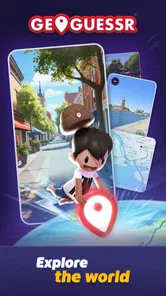
GeoGuessr is a geography game that drops you into a location on a map, usually shown through Google Street View or another supported map source. You look for clues such as road signs, language, vegetation, architecture, and road markings, then place a guess on the world map. The closer your guess is to the actual location, the more points you earn. Available modes and features can vary.
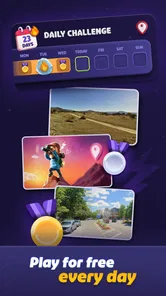
GeoGuessr may let you try some gameplay without paying, but access to modes, rounds, or the amount of play available can depend on the current app and account options. A subscription or other paid purchase may be required for broader or uninterrupted access. Check the app’s store listing and in-app purchase details before downloading, since prices, trial offers, and plan features can change by region and over time.
GeoGuessr relies on online map imagery and game services, so you should expect to need a stable internet connection to play. Connection quality can affect how quickly locations and map views load, particularly when using mobile data or a weaker Wi-Fi network. If you plan to play while travelling, check your data allowance and roaming costs; offline play should not be assumed unless the app explicitly offers it.
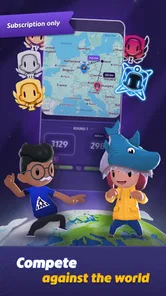
GeoGuessr offers ways to make the experience competitive, including multiplayer or challenge-style play where available. Depending on the mode, you may be able to join friends, compare scores, or compete with other players. The exact options can change with app updates, account type, and region, so review the current menus and any access requirements. Multiplayer sessions also need a reliable connection for a smoother experience.
Before installing GeoGuessr, review its current privacy policy and the permissions requested by the app. Gameplay uses online map content and may involve account information, while optional features could request additional access. Avoid sharing sensitive details in public profiles or chats, and check the app store’s privacy labels for the latest information about data collection and use. Permissions and practices may vary by platform and can change with updates.
On Android, GeoGuessr asks for these permissions.
GeoGuessr is also available in 2 other languages on our site.
3.8 out of 5
88,260 reviews
Trivia · GeoGuessr

Trivia4.7 out of 5

Trivia4.8 out of 5

Trivia4.4 out of 5

Trivia4.7 out of 5
Trivia4.6 out of 5

Trivia4.4 out of 5
Trivia4.5 out of 5

Trivia4.7 out of 5

Trivia4.8 out of 5

Trivia4.8 out of 5
Trivia4.8 out of 5
Trivia4.8 out of 5

Trivia4.7 out of 5

Trivia4.5 out of 5

Trivia4.8 out of 5
Trivia4.1 out of 5
Trivia4.6 out of 5
Trivia4.8 out of 5


Gamesive reviews games on its own and is not paid by developers for scores. We do not host game files: the download buttons open the official Google Play and App Store pages. Names, icons and screenshots belong to their owners.