Brain Test: Tricky Puzzles
For Android & iOS · Unico Studio
- 4.7 out of 5Rating
- 10.05MReviews
- 100.00M+Downloads
- TriviaGenre
Game details
- Version
- Varies with device
- Updated
- Requires
- 7.0
- Price
- Free
- Age rating
- Everyone
- In-app purchases
- $0.99 - $7.99 per item
Screenshots
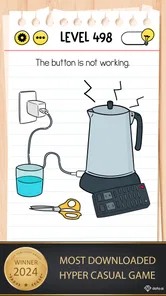
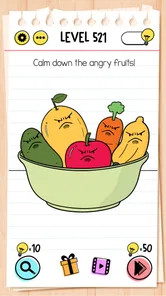
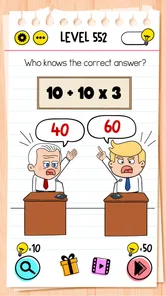
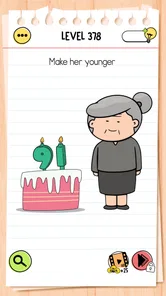
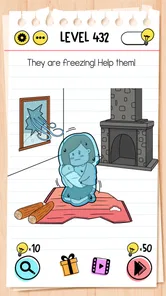
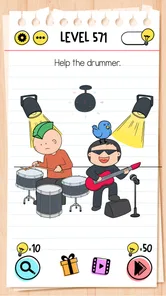
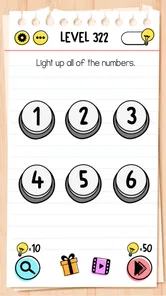
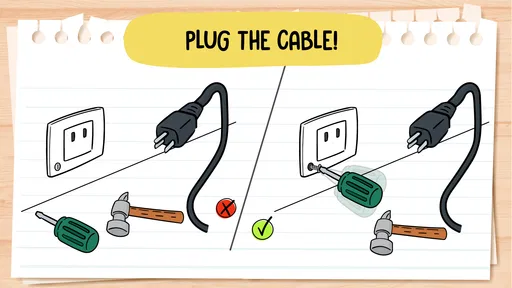
Brain Test: Tricky Puzzles review
 Analysis by Gamesive
I’d choose Brain Test: Tricky Puzzles when I want a quick mental detour, not a formal brain-training course. It is a trivia game built around puzzles that reward looking at a situation differently, and that playful approach is the main reason I find it appealing. It asks for attention and lateral thinking, but the experience is meant to entertain rather than measure intelligence in any serious way.
The important decision is whether you enjoy being surprised by a puzzle’s interpretation. If you expect conventional trivia, where you recall a fact and select the correct answer, this may not be your kind of quiz. Here, a prompt can invite you to inspect the whole screen and question what the obvious answer assumes. I find that shift charming when I’m in the mood for a small challenge, though it can also make a wrong answer feel like a trick rather than a lesson.
What makes its puzzle style work
Unico Studio’s game has a light, accessible feel that suits short sessions. Its store description calls attention to IQ-testing and tricky brain puzzles, but I would treat the IQ angle as playful framing, not a meaningful score of anyone’s ability. The more useful question is whether you like puzzles that ask you to pause, notice details, and try an unexpected interpretation.
That distinction matters when comparing it with the usual alternatives. Fact-focused trivia is better if you want to learn or recall information about subjects such as history, science, or entertainment. Conventional logic games may suit you more if you prefer consistent rules and a clear progression of difficulty. Brain Test sits between those habits: its appeal is the surprise in how a prompt should be read, rather than a deep subject curriculum or a strict logic framework.
A practical tip is to read each prompt twice before tapping. On a first pass, I look for the literal request; on the second, I check whether a visual detail or an assumption is doing more work than the wording suggests. This small routine makes the puzzles feel less like random guessing and gives the game a better chance to test observation rather than impatience.
It also works well as a shared, low-pressure activity. If I’m waiting for food with a friend, we can take turns proposing answers and explain why we think a detail matters. That makes a puzzle last longer without needing a formal multiplayer mode: the fun comes from comparing interpretations. For a solo break, the same format is easy to pick up when I have a spare moment and put down when I don’t.
When its trickiness is a strength
The game’s best moments come when I realize I have focused too narrowly. Instead of treating the wording as a standard quiz question, I need to inspect the scene and consider what the game might be asking me to notice. That makes the solution satisfying when the clue feels fair in hindsight. It is a different pleasure from knowing an obscure fact or completing a long chain of deduction.
There is a useful trade-off here: a surprising answer is memorable, but a puzzle built around an unexpected interpretation can be hard to reason through if I don’t see the intended cue. When that happens, I try changing one assumption at a time rather than tapping randomly. For example, I’ll reconsider whether the prompt is asking for the obvious object, the relationship between objects, or a less literal reading. That approach keeps the challenge thoughtful instead of turning it into trial and error.
Because the puzzles are designed to be approachable, I’d recommend it to casual players, families looking for a conversational game, and anyone who enjoys wordplay or visual misdirection. It can also suit someone who usually avoids trivia because they don’t want to be tested on facts. The challenge comes from how you interpret the prompt, not from needing a store of specialist knowledge.
When another kind of game is a better fit
I would skip it if I wanted a dependable measure of cognitive progress, a structured learning tool, or a serious quiz night built around factual knowledge. The playful framing is part of its identity, but it also means that a clever answer is not necessarily evidence of a broad skill. Players who dislike being caught out by a twist may find the humor more irritating than rewarding.
It may also be a poor choice when I want a puzzle with a transparent rule set and a single, carefully reasoned path. Some players enjoy exploring possible interpretations; others want instructions that establish exactly what counts as a valid move. If you belong to the second group, a traditional logic puzzle or subject-based quiz is likely to feel more satisfying. The right comparison is not which format is objectively better, but whether you want surprise or consistency.
Another trade-off is the way short puzzles invite frequent stopping and starting. That is convenient during a brief break, but it does not automatically create the focused, uninterrupted feeling of a long puzzle session. I’d use it for a few rounds while waiting or unwinding, rather than choosing it as my only game for a dedicated evening of deep problem-solving.
Making a short session more satisfying
To get more from a puzzle, I avoid asking for help immediately. I first restate the prompt in my own words, then inspect the scene for something I ignored. If I’m stuck, I take a short pause and return with fresh eyes instead of repeating the same taps. This is especially helpful with trick questions: stepping away can reveal that I was locked into the most familiar reading.
When playing with someone else, I’d agree to give each person time to explain an answer before revealing a solution. The explanation is often more entertaining than the tap itself, and it helps distinguish a genuine observation from a lucky guess. For a younger player, I’d keep the tone collaborative rather than treating every puzzle like a test. The game carries an Everyone age rating, which makes it broadly accessible, but individual children will still vary in how they respond to tricky wording.
It is free to download, while optional in-app purchases range from $0.99 to $7.99 per item. I’d decide whether the core style is enjoyable before spending anything. If I’m only opening it now and then, there is little reason to rush into a purchase; if I become a regular player, I can weigh the available options in the app itself. The key is to regard purchases as optional rather than necessary to justify trying a free game.
Popularity, access, and the choice to keep it
Brain Test has a 4.7 average rating from around 10 million ratings, and it has passed 100 million installs. Those figures suggest that its blend of approachable challenges and playful surprises has reached a large audience, but popularity cannot tell me whether I’ll enjoy its particular style. I would use them as context, then make the decision based on whether I like the first few puzzles and how the game handles the kind of challenge I want.
It was released on November 21, 2019, and requires Android 7.0 or later. That makes the minimum operating-system requirement worth checking before downloading on an older device. The age rating is Everyone, and the game is categorized as trivia, though its actual appeal is closer to lateral-thinking puzzles than a standard knowledge quiz. These details help set expectations: it is an accessible casual game, not a specialist study tool.
Switching to another game is easy if the format doesn’t click, because the choice is really about taste rather than learning a complicated system. If you prefer fact recall, choose a conventional trivia title; if you want a carefully bounded logic challenge, choose a game built around explicit rules. If you stay with this one, give yourself permission to think laterally and stop when the tricks stop being fun. That is a better test of fit than trying to finish every puzzle at once.
My recommendation
I recommend Brain Test: Tricky Puzzles to anyone who wants amusing, bite-sized challenges and enjoys discovering that a question was not asking what they first assumed. Its strongest use is a short solo break or a playful back-and-forth with another person. I like it most when I approach each puzzle with curiosity rather than expecting a serious IQ assessment or a conventional trivia lesson.
Choose something else if you need educational depth, predictable logic, or a rigorous measure of skill. For everyone else, this is an easy free game to try, with optional purchases if you decide to keep playing. I’d start with a few puzzles, pay attention to whether the surprises feel clever or frustrating, and let that decide whether it earns a place on your phone.
What we like
- Puzzles reward careful observation and creative thinking.
- Short levels make it easy to play in spare moments.
- A hint system can help when a puzzle feels unclear.
- The playful presentation keeps the challenges lighthearted.
- Many puzzles encourage trying unexpected solutions.
What could be better
- Some answers depend on wordplay that may feel arbitrary.
- Hints may be limited unless you watch ads or spend resources.
- Repeated ad breaks can interrupt the flow.
- Later puzzles can feel inconsistent in difficulty.
- Progress may be frustrating if you get stuck without hints.
Frequently Asked Questions
What is Brain Test: Tricky Puzzles?
Brain Test: Tricky Puzzles is a casual puzzle game built around short riddles and unconventional challenges. Each level presents a question or visual scene, and the expected solution may involve tapping, dragging, combining, or moving objects rather than simply choosing an answer. The game is designed for quick play, but its deliberately misleading clues can make some puzzles surprisingly tricky.
Is Brain Test: Tricky Puzzles free to download and play?
The game is generally available to download for free, so you can try its puzzles without paying upfront. It may include advertisements and optional in-app purchases, and the amount or availability of these can vary by platform, region, or version. Check the store listing before installing for current pricing and purchase details, and review your device’s settings if you want to manage ads or spending.
Does Brain Test: Tricky Puzzles work offline?
Many of the core puzzles can typically be played without a continuous internet connection once the game is installed, which makes it convenient for short sessions while travelling. However, features such as advertisements, purchases, updates, or other online content may require connectivity. Offline access can also depend on the current version and device, so it is sensible to check that the game launches and loads levels before relying on it without internet.
Is Brain Test: Tricky Puzzles suitable for children?
The game uses cartoon-style visuals and short, mostly language-based riddles, so it can be approachable for families and younger players. Some solutions rely on wordplay or unexpected logic, which may be challenging for children without help. Because the game may contain advertisements or optional purchases, parents should check the current store age rating and consider using device-level parental controls before allowing a child to play.
What should I do if I get stuck on a Brain Test: Tricky Puzzles level?
Read the prompt carefully, inspect the whole screen, and try interacting with objects rather than assuming the answer must be a standard multiple-choice response. Some levels reward dragging items, changing their positions, or thinking about the wording in an unusual way. If you remain stuck, use an available in-game hint if offered, but keep in mind that hint access and any related costs may vary by version.
Permissions
On Android, Brain Test: Tricky Puzzles asks for these permissions.
- Wi-Fi connection information
- view Wi-Fi connections
- Other
- view network connections, full network access, control vibration, prevent device from sleeping, Google Play license check
Languages
Brain Test: Tricky Puzzles is also available in 2 other languages on our site.
User reviews
4.7 out of 5
10,053,564 reviews
- 81%
- 15%
- 2%
- 1%
- 2%
Download Brain Test: Tricky Puzzles
Trivia · Unico Studio · Free
Games like Brain Test: Tricky Puzzles
View all: Games like Brain Test: Tricky Puzzles
Text or Die
Trivia4.1 out of 5
Everyday Puzzles: Mini Games
Trivia4.6 out of 5
IQ & brain test: Triviascapes
Trivia4.8 out of 5

Fluffy Drop - No Timer
Trivia4.5 out of 5
About this listing
- Game
- Brain Test: Tricky Puzzles
- Developer
- Unico Studio
- Package
- com.unicostudio.braintest
- Version reviewed
- Varies with device
Gamesive reviews games on its own and is not paid by developers for scores. We do not host game files: the download buttons open the official Google Play and App Store pages. Names, icons and screenshots belong to their owners.