
Geometry Dash Lite
Arcade4.4 out of 5

For Android & iOS · Halfbrick Studios

 Analysis by Gamesive
I keep coming back to Fruit Ninja® for a particular reason: it turns a spare minute into a quick test of timing and restraint. The idea is easy to grasp, but a good run depends on more than swiping as fast as possible. You watch the fruit, choose when to move, and try not to let excitement turn a clean slice into a careless miss. That makes it a satisfying arcade game when I want something immediate rather than a long session with a tutorial or story to follow.
Made by Halfbrick Studios, this free arcade game has been around since July 20, 2011, and its staying power is easy to understand once you play. It has a 4.4 average from around 5.3 million ratings, with over 500 million installs. Those figures point to a familiar, widely played game, but they do not guarantee that its simple loop will suit everyone. My impression is that it works best when I treat it as a focused little challenge, not as a game that needs to occupy an entire evening.
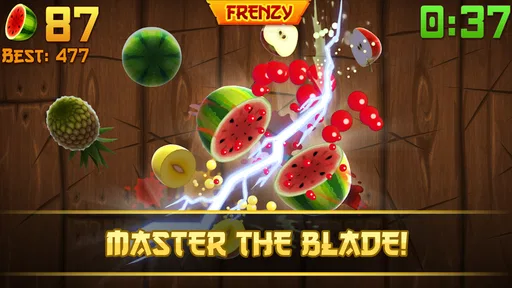
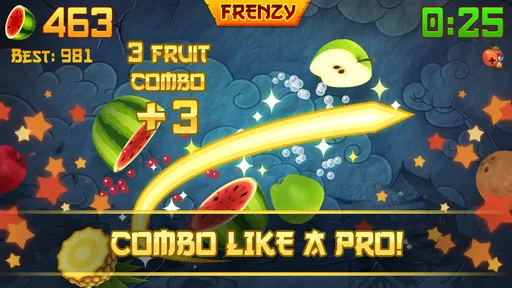
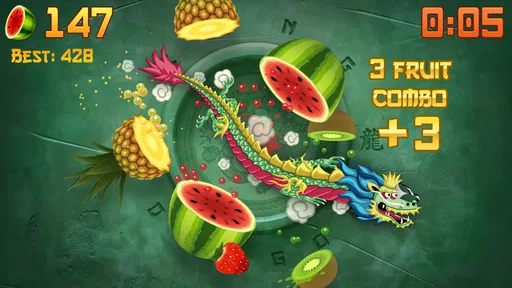
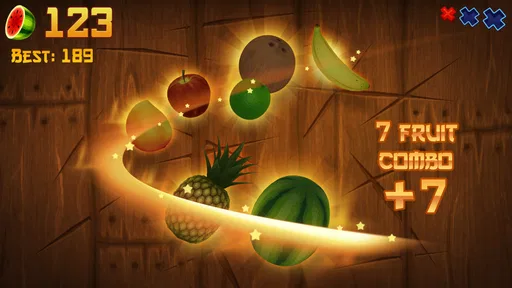
The appeal is immediate: fruit appears, and I swipe across the screen to slice it. The control is simple enough for a first attempt, yet the way I use it matters. Broad, frantic motions can feel productive, but they also make it harder to judge what I am cutting. I get more consistent results when I keep my movements deliberate and wait until the fruit gives me a clear line to follow.
That small change in approach is the first useful habit to build. Instead of reacting to every piece separately, I watch for fruit that can be caught in one smooth pass. A single controlled swipe can be more reliable than several quick corrections, especially when the screen becomes visually busy. I also try to leave myself room to react rather than dragging my finger continuously across the display.
The game is particularly suited to short breaks: a few minutes while waiting for a friend, a pause between tasks, or a quick wind-down before putting my phone away. Starting a round takes little commitment, and the core action does not require me to remember a plot or manage a complicated collection of systems. If I have only a moment, that low setup cost is a genuine strength.
For a casual player, the best baseline workflow is straightforward: begin a round, settle into the pace, and focus on clean decisions instead of chasing every possible swipe. When I notice myself moving faster just because the action is lively, I slow down and look for the next useful opportunity. That makes the game feel less like random tapping and more like a small exercise in timing.
My practical advice is to check the available settings and options before settling into a routine. I avoid assuming that a default setup is automatically the most comfortable one: screen orientation, sound, and control preferences can affect whether a quick session feels pleasant in a quiet room or on the move. The specific choices available can vary with the version and device, so I would inspect the menus rather than rely on a remembered guide.
It is also worth deciding what kind of session you want before you start. If I am playing in a noisy place, I make sure the audio will not be distracting; if I am trying to concentrate, I choose a comfortable grip and keep the phone steady. These are modest adjustments, but they reduce friction. They do not make the game easier by magic; they make it easier for me to pay attention to the actual timing.
The current version is 3.98.4, and the game is listed for Android devices running version 6.0 or later. It is rated Everyone, which makes the straightforward fruit-slicing premise accessible to a broad audience. Still, I would be aware of the purchase model: the game is free to install, with optional in-app items priced from $0.99 to $179.99 each. I would check purchase prompts carefully, particularly if a child is playing or the device is shared.
That free-to-start structure is a useful distinction when deciding whether to try it. I can sample the core arcade action without paying upfront, but I would not treat every optional purchase as necessary to enjoy a quick round. If I prefer games with a single upfront cost and no in-app purchase menu, this may feel less comfortable than a paid, self-contained alternative. The sensible approach is to play the basic loop first and decide whether anything offered later genuinely improves my own experience.
One non-obvious improvement is to make each attempt answer a small question. I might focus on waiting for a better grouping, keeping my swipe path controlled, or resisting the impulse to chase a fruit that would force an awkward movement. That turns a run into useful practice even when the score is not impressive. Randomly changing everything from one attempt to the next makes it harder to tell what helped.
I also recommend taking a short pause after a careless mistake. In a game built around fast reactions, immediately launching into another attempt while annoyed can encourage the same rushed behavior. A breath, a reset of my grip, and a clear intention for the next run are often more useful than trying to compensate with faster swipes. This is a simple routine, but it makes the game feel more controlled.
Another practical tip is to keep the device position consistent. If I switch between holding the phone loosely, resting it on a table, and changing hands, my swipe angle and reach change too. Picking a comfortable posture for a session makes it easier to judge movement. This matters most when I am trying to improve steadily rather than simply passing time.
Compared with endless runners, Fruit Ninja asks less of my navigation and more of my timing. Compared with puzzle games, it gives me less time to sit and plan. Its appeal is the short, tactile feedback of a swipe that lands cleanly. That is also its trade-off: anyone who wants a layered campaign, a large strategic build, or a quiet problem to solve may find more satisfaction in another kind of arcade or puzzle game.
With practice, the biggest gain is not superhuman speed; it is better selection. I learn to avoid unnecessary movements and to recognize when a swipe is likely to be messy. That shift makes play feel more intentional and gives me a repeatable way to approach a round. Experienced players can use the same basic loop as newcomers, but they tend to get more out of restraint and consistency than raw finger speed.
There is a limit to how far that mastery can take someone who wants constant novelty. The central action remains slicing fruit, so if I have already had my fill of that rhythm, playing longer does not suddenly turn the game into a different experience. Repetition is part of the design’s strength, but it can also become the reason I put it down. I would not recommend it as a substitute for a game with a strong narrative or substantial long-term planning.
Touch comfort is another personal consideration. The swipe-based control is the whole point, so players who dislike gestures or find repeated finger movement uncomfortable may not enjoy extended sessions. I would keep play brief and stop if my hand feels tired. The game is easy to pick up, but that does not mean every player will find its physical interaction pleasant for long stretches.
It is also not the right pick when I want a calm, interruption-proof activity that rewards careful thought without visual urgency. Fruit Ninja is more appealing when I am ready to react and accept that some attempts will be imperfect. If I want to relax by reading, exploring, or planning at my own pace, a slower mobile game is a better fit. Knowing that distinction helps me enjoy this one for what it is instead of expecting it to provide every kind of entertainment.
I recommend Fruit Ninja® to someone who wants an uncomplicated arcade game that can be understood quickly and played in short bursts. It is a particularly easy recommendation for a casual player who enjoys improving through repetition, or for someone looking for a simple game to share informally with family. Its Everyone age rating supports that broad appeal, while the purchase options are a reason to keep an eye on spending settings on a shared device.
My most useful routine is simple: check that the controls and sound suit the moment, get comfortable holding the phone, and choose one habit to work on during a run. I focus on clean swipes rather than constant motion, pause when frustration sets in, and stop when the repeated loop no longer feels enjoyable. Those choices make a bigger difference to my experience than treating every session as a score chase.
Ultimately, I see this as a dependable pocket-sized arcade distraction rather than a deep game. Halfbrick Studios built a premise that still works because the action is clear and the feedback is immediate, but its simplicity is both its charm and its ceiling. If that compact challenge sounds appealing, the free install makes it easy to try. If you need a campaign, a substantial strategic layer, or a slower pace, I would choose a different game instead.
Fruit Ninja® is an arcade game built around a simple action: swipe across the screen to slice fruit as it appears. In the classic mode, you try to score as many points as possible while avoiding bombs, which can end a run or cost you points depending on the mode. Other modes add different rules and goals, so the game can feel more varied than its straightforward controls initially suggest.
Fruit Ninja® is generally offered as a free download, but availability, pricing, and in-app purchase options can vary by platform, region, and version. Some items or features may be offered for purchase, and the game may include advertising. Check the current Google Play or Apple App Store listing before installing to see the latest price, purchase details, and any restrictions that apply to your device.
Many of Fruit Ninja®’s core arcade-style activities can be played without a continuous internet connection, making the game suitable for short sessions on the go. However, connectivity may be needed for certain online features, account services, events, or purchases, and availability can depend on the current version. If offline access matters to you, launch the game once while connected and check which modes remain available without internet.
Fruit Ninja® uses bright, cartoon-style fruit and playful visual effects rather than realistic violence, and its swipe-based gameplay is easy to understand. Still, parents should review the current store age rating and the game’s settings, because ratings and available content can differ by region and update. Also check for advertising, in-app purchases, and any online features before letting a child play, and use device-level purchase controls if needed.
Fruit Ninja® is designed for touchscreens, so responsive swipes make a noticeable difference to the experience. Before downloading, confirm that your device meets the requirements shown on its official app-store listing and that you have enough storage for the game and updates. The version, features, and performance may differ between Android and iOS, while ads or optional purchases may be present, so review the listing for your platform.
On Android, Fruit Ninja® asks for these permissions.
4.4 out of 5
5,291,673 reviews
Arcade · Halfbrick Studios

Arcade4.6 out of 5

Arcade4.5 out of 5

Arcade4.2 out of 5

Arcade4.7 out of 5

Arcade4.3 out of 5

Arcade4.5 out of 5

Adventure4.7 out of 5
Arcade4.4 out of 5

Arcade4.6 out of 5

Arcade4.2 out of 5

Arcade4.5 out of 5

Arcade4.7 out of 5

Arcade4.5 out of 5

Arcade4.4 out of 5

Arcade4.4 out of 5

Arcade4.2 out of 5

Arcade4.7 out of 5

Arcade4.8 out of 5

Arcade4.6 out of 5



Gamesive reviews games on its own and is not paid by developers for scores. We do not host game files: the download buttons open the official Google Play and App Store pages. Names, icons and screenshots belong to their owners.