
Solar Smash
Simulation4.6 out of 5

For Android & iOS · Candywriter, LLC





 Analysis by Gamesive
When a game gets passed around a household, the first question is often whether it works as a quick shared conversation or demands one person’s uninterrupted attention. BitLife fits the conversation side: it turns a fictional life into a chain of choices, and the surprising outcomes can be more entertaining to discuss than to optimize. I like it best as a personal, pick-up-and-play simulation that people nearby can comment on, rather than as a multiplayer game or a shared family project.
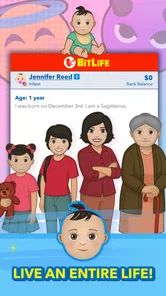
BitLife is a free life-simulation game from Candywriter, LLC. Instead of asking me to build a city or manage a household in real time, it presents life as a sequence of decisions and consequences. That makes it easy to start a run when I have a spare moment, then put the game down and come back to another fictional life later.
The central appeal is the freedom to make choices without treating every run as a serious attempt at success. I can play cautiously, chase an unusual outcome, or deliberately make a string of questionable decisions just to see how the story develops. The fun comes from watching one choice set up the next, not from mastering a complicated control scheme.
That format also gives the game an easy social rhythm. Someone can read out a surprising dilemma, invite opinions, and then choose for themselves. It is a good fit for a short break, a commute, or a casual chat on the sofa, provided the person playing is comfortable with mature themes. It is not designed around several people controlling the same character together, so a group should treat suggestions as commentary, not as a formal shared save.
For a household, I would decide in advance whether the device is being handed over for a quick look or whether each person is playing their own session. The game’s appeal depends on personal choices, and another person taking over mid-run can change the direction of a life in ways the original player did not intend. If that would cause friction, keep play separate rather than treating one ongoing life as a communal activity.
This is especially useful on a shared device. Agree who is playing before opening the game, and avoid assuming that a younger sibling or child can simply browse freely because the game looks light and cartoonish. A life simulator can feel playful while still covering adult situations. I would not use it as an unplanned all-ages pass-around game.
BitLife is a better shared experience when one person holds the device and the others react to decisions. That preserves a clear player while keeping the funny, dramatic, or awkward outcomes conversational. It also avoids confusing advice with control: the person playing can listen, ignore suggestions, and own the result.
There is no need to turn a casual game into a household project, but a little clarity helps. If a device belongs to more than one person, decide whether the game is for one player or for occasional handoffs. If someone is borrowing it, make sure they know not to continue a run that belongs to another player. That simple boundary is more practical than expecting a life story to remain untouched after an informal pass-around.
The game is free to download, with in-app purchases listed from $0.99 to $27.99 per item. That makes it sensible to establish a purchase rule before letting someone else use the device: a free download does not mean every optional purchase is free. I would keep purchase decisions with the account holder, particularly when a child or guest is playing, and check the app store’s purchase settings for the device rather than assuming the game itself provides household controls.
That distinction is important because the choice-driven format can encourage curiosity: a player may want to explore more options or continue experimenting. A clear rule about spending prevents a casual handoff from becoming an unexpected purchase. I would also avoid promising that progress or access is shared between different people; treat the game as an individual app experience unless you have confirmed how your own device and account handle it.
One practical way to enjoy it with others is to make each run a small story session. The player can explain the decision they are facing, hear a couple of opinions, then choose quickly. That works because the game’s basic unit is a choice, not a long stretch of coordinated action. It can create a fun debate without requiring everyone to understand a complex strategy first.
I would keep that discussion light. If the group insists on choosing every move, a short game can become a negotiation, and the person holding the device may feel they have lost the point of playing. A better arrangement is to let the player set the tone—serious, chaotic, or simply curious—and invite advice only when a decision seems interesting.
For younger players in particular, it is worth agreeing on what kind of conversation is welcome. Some decisions may raise uncomfortable topics, and people can react differently to the same fictional situation. A household can make the experience more comfortable by letting anyone opt out of a run or hand the device back without needing to defend that choice.
The game carries a Mature 17+ content rating, so I would take that seriously rather than judging it by its simple presentation. It is intended for mature players, and a parent or caregiver should make the decision for a younger person based on the game’s content and the child’s maturity. The fact that choices are fictional does not automatically make every theme suitable for every age.
That age context matters even when the game is played in a common room. A visible screen can invite questions from someone who was not planning to play, and a shared device can make it harder to know who will see a particular run. If the player is under the recommended age, I would review the app and its content with them first rather than using household visibility as a substitute for guidance.
There is also a trust issue in how the game is used. It is a sandbox for fictional decisions, not a lesson plan or a reliable guide to real-life outcomes. I find it more enjoyable when everyone understands that the point is to explore a made-up life and react to the story, not to judge a player’s character by the choices they try in a game.
Compared with the usual simulation alternatives, BitLife is less about arranging a detailed world and more about responding to prompts as a character’s life unfolds. If I want fine-grained control over a home, a city, or a production system, another kind of simulation will likely suit me better. If I want a lightweight story shaped by decisions, this format is more immediate and easier to play in short bursts.
That simplicity is both its strength and its limitation. The game gets me to a decision quickly, which is handy when I only have a few minutes. But players who want tactile building, elaborate planning, or a deep shared-management experience may find the choice-led approach thin. It is also not the right pick for a household looking for a child-friendly game to hand around without checking the age rating.
The game has a 4.4 average from around 1.3 million ratings, and it has passed 50 million installs. Those figures suggest a broad audience, but they do not tell me whether its particular style will suit someone who prefers hands-on simulation. I would use the rating as context, not as a substitute for considering the mature content and the game’s emphasis on reading and choosing.
BitLife was released on February 5, 2019, and its current version is 3.26.1. It requires Android 7.1 or later. That matters if the intended device is older: check compatibility in the app store before planning a shared session, especially if the household relies on one particular phone or tablet.
Because the game is built around individual decisions, it is easy to mistake its approachability for endless novelty. I would recommend trying a few different styles of play rather than expecting every run to feel dramatically different. A deliberate, cautious life and an intentionally unpredictable one can make the same basic structure feel quite different, but anyone who dislikes replaying a choice-based format may tire of it sooner.
The most useful way to approach a new run is to decide what you want from it before making choices: a believable story, an unusual outcome, or simply a few amusing surprises. That small intention gives the decisions a thread and makes the results easier to enjoy. It also helps when others are watching, since they can follow the story rather than treating every choice as a vote.
I recommend BitLife to adults who enjoy quick, text-led simulations and want a game that can spark conversation without requiring a group to play at the same time. It works particularly well for a short break or a relaxed shared-device moment where one person plays and others offer reactions. Its strongest household use is as a source of fictional stories, not as a coordinated multiplayer activity.
I would skip it for young children, for anyone seeking a reliably all-ages family game, and for players who want detailed building or real-time teamwork. The mature rating, purchase options, and personal nature of its choices make clear boundaries worthwhile on a shared device. With those expectations set, I find it an entertaining little life experiment; without them, another simulation with more hands-on control or a more suitable age range may be the better choice.
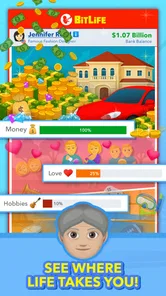
BitLife - Life Simulator is a text-based life simulation game in which you guide a character through choices from birth to old age. You can shape their education, career, relationships, finances, health, and behavior, with events and outcomes changing according to your decisions. Rather than controlling a character in a visual world, you read scenarios and choose how to respond, making each playthrough different.
BitLife can be downloaded and played for free, but it may offer in-app purchases for extra features, content, or access options. The exact offerings and prices can vary by platform, region, and version, so check the store listing before downloading. You can explore the basic life-simulation experience without assuming every feature is included at no cost, and purchases should be reviewed carefully, especially on a device used by children.
BitLife includes themes that may not be appropriate for younger players, such as crime, substance use, sexual relationships, illness, and other mature life situations. The content is presented in a simplified, text-based style, but that does not make every scenario child-friendly. Check the age rating and content information in the Google Play Store or Apple App Store, and consider using device-level parental controls if children may access the game.
Some parts of BitLife may be playable without an internet connection, but connectivity can be needed for certain features, updates, advertisements, purchases, or online services. Offline availability can also change between app versions and platforms. If you expect to play while traveling or without reliable data, install the game and test it beforehand, and do not assume that every activity or optional feature will remain accessible offline.
BitLife is available through official app stores on Android and iOS, though availability and supported features can differ by country, device, and version. Progress transfer between platforms or devices is not guaranteed, so check the game’s current account, cloud-save, and backup options before changing phones or switching operating systems. To avoid losing a character or save, keep the app updated and follow the platform’s recommended backup process.
On Android, BitLife - Life Simulator asks for these permissions.
BitLife - Life Simulator is also available in 1 other languages on our site.
4.4 out of 5
1,319,268 reviews
Simulation · Candywriter, LLC

Simulation4.3 out of 5

Simulation4.2 out of 5

Simulation4.4 out of 5

Simulation4.6 out of 5

Simulation4.7 out of 5

Simulation4.5 out of 5
Simulation4.6 out of 5

Simulation4.5 out of 5

Simulation4.5 out of 5

Simulation4.1 out of 5

Simulation4.4 out of 5

Simulation4.5 out of 5

Simulation2.9 out of 5

Simulation4.5 out of 5

Simulation4.5 out of 5

Simulation4.8 out of 5

Simulation4.3 out of 5

Simulation4.5 out of 5



Gamesive reviews games on its own and is not paid by developers for scores. We do not host game files: the download buttons open the official Google Play and App Store pages. Names, icons and screenshots belong to their owners.