
Block Craft 3D:Building Game
Arcade4.5 out of 5

For Android & iOS · VOODOO

 Analysis by Gamesive
I find Crazy Kick! works best when I want a quick burst of arcade action rather than a full football match. I steer a ball through a compact challenge, look for a route past the defenders, and try to finish with a goal. The idea is easy to grasp, but getting the ball where I intend takes more care than the simple premise suggests. That small gap between knowing what to do and doing it well is what makes another attempt tempting.
It is an arcade game from VOODOO, released on August 30, 2019, and it has grown into a widely played pick-up-and-play option: it has over 100 million installs and an average rating of 4.5 from around 252,000 ratings. Those figures tell me it has broad appeal, but they do not mean it will suit every football fan. Its appeal is less about tactical depth or realistic matches and more about controlling the ball, reading the immediate obstacle in front of me, and making a clean finish.
The central pleasure is direct: I control the ball, work around eleven soccer players, and aim to score. That gives each round an obvious objective, so I do not need to learn a team’s formation, manage a season, or remember a complicated set of controls before I can get going. The game is at its most inviting when I have a spare moment and want something with a clear beginning and end.
That clarity also makes the early goals satisfying. A successful shot gives immediate feedback that my approach worked, while a blocked or poorly aimed attempt points to a simple question: did I choose the wrong line, or did I move the ball carelessly? I like that the basic challenge is readable without turning the experience into a football simulation. The focus stays on the moment of approach and the finish.
For a realistic everyday use case, I could open it while waiting for a drink or taking a short break between tasks. A quick attempt can feel complete on its own, rather than demanding the uninterrupted time I would set aside for a full match in a conventional football game. That is a meaningful strength, especially for someone who enjoys quick arcade rounds but does not want to coordinate a team or follow a longer competition.
The trade-off is that the football theme should not set the wrong expectation. I would not pick this as my main game for learning tactics, building a squad, or competing in extended matches. The ball is the star, and the defenders are obstacles to solve in the immediate play. If what I want is the fuller rhythm of passing, defending, and changing possession, a traditional football game is a better fit.
The useful skill here is restraint. When I see a gap, my first impulse can be to rush directly toward it, but a more careful line gives me a better chance to keep control and set up a sensible shot. I treat each attempt as a small route-planning problem: spot where the defenders are, avoid making unnecessary movements, and leave myself room to finish. That is more rewarding than simply pushing forward as fast as possible.
One practical tip is to pay attention to the approach, not only the shot. If I repeatedly reach the goal area in a poor position, changing how I steer earlier can matter more than trying to force a last-second finish. This is a modest but useful distinction: the goal is the visible reward, while the decisions leading up to it are where much of the control challenge sits.
I also find it helps to make one deliberate adjustment after a failed attempt instead of changing everything at once. If I altered my direction too sharply, I can try a gentler line; if I charged into pressure, I can look for a calmer opening. That keeps retries informative. It is a better way to enjoy an arcade challenge than treating every miss as a reason to tap frantically and hope the next run works.
In a simple game like this, progress can feel less like a long checklist and more like improved control: I notice openings sooner, take a cleaner route, and finish with fewer awkward corrections. That sort of progress is personal and immediate. It gives me a reason to return even when I am not chasing a deep career mode or a complex collection of long-term goals.
Unlocks can add a reason to keep playing, but I would not judge the game solely by how many things it offers to collect. The more durable reward is learning how to handle the ball through pressure and turn a promising approach into a goal. If I am the sort of player who needs a detailed progression map, regular new objectives, or extensive customization to stay engaged, this may feel thin. If I enjoy improving at one compact action, its smaller scope is easier to appreciate.
A useful way to decide whether it is holding my attention is to notice what I am looking forward to on the next attempt. If I want to refine a route or make a cleaner finish, the core challenge is still working. If I am only continuing because I feel obliged to reach another unlock, the play itself may not be enough for me. That distinction matters because quick arcade games are strongest when the moment-to-moment action remains enjoyable without a large reward structure behind it.
I would also set expectations around variety. The basic loop is built around getting past defenders and scoring, so the pleasure comes from executing that goal rather than switching between football roles. That makes the game easy to return to, but it can also make repeated sessions feel similar. A short play session suits it better than expecting hours of fresh systems or a steady stream of radically different match situations.
The difficulty is best approached as a test of timing and control rather than knowledge of the sport. Being familiar with real football may help me read the scene intuitively, but it is not the same as managing a match. The important question is whether I can move the ball with enough precision to navigate the defenders and set up a score. That keeps the entry barrier low, while leaving room for the execution to become frustrating when I want a particular route to work.
When a level or attempt feels harder, I try not to assume that speed is the answer. A rushed movement can spoil a good position, while a small change of angle may open a path that was not obvious at first. The game’s challenge is most satisfying when a miss teaches me something about the approach. It is less satisfying if I expect every attempt to be effortless or if I dislike repeating a compact task while trying to improve.
That makes it a reasonable choice for casual players who like trying again after a near miss. It is less suitable for someone who gets irritated by precision-based play or wants a dependable, low-effort win every time they open a game. I would recommend approaching it with a light mood: the short format makes a failure easy to leave behind, but the desire to perfect a run can still pull me into repeated attempts.
The same short-session design that makes the game convenient can encourage me to keep going longer than I planned. A goal feels like a natural stopping point, yet a close miss can make one more try feel almost compulsory. That is a familiar arcade-game tension: the next attempt is easy to begin, and the small scale makes it tempting to believe that a better result is just around the corner.
I would use a simple boundary if I only have a few minutes: decide before opening the game whether I am playing for a short break or settling in for a longer session. That is especially helpful if I tend to replay challenges until I get a clean result. The game can be an easy way to fill idle time, but it is not necessarily the best choice when I need a firm stopping point or want a session with a clearly defined end beyond my own decision.
Crazy Kick! is free to download, with in-app purchases priced from $0.99 to $69.99 per item. I would keep that range in mind before spending, particularly because the core appeal is a straightforward arcade loop rather than a deep football management experience. The game is rated Everyone, which makes its broad, accessible premise easy to understand, but adults and children alike should still be thoughtful about optional purchases and how quickly a casual session can stretch.
I would recommend it to someone who likes compact, skill-focused arcade games and wants football flavor without the commitment of a full match. It is also a good candidate for brief breaks, especially if the satisfaction of threading a ball past defenders matters more than realistic team play. Its current version is 2.49.0, and it requires operating system version 8.0 or later, so it is worth checking that compatibility before trying to install it.
I would steer a football fan toward a conventional match game if they care most about tactics, passing combinations, team selection, or a longer competitive structure. I would also suggest a different kind of arcade game to anyone who wants a wide variety of mechanics from session to session. Here, the central pleasure is focused: control the ball, get through the defensive pressure, and score. That focus is a strength when I want exactly that, and a limitation when I want more.
Against the usual alternatives in the arcade category, Crazy Kick! is appealing because it turns a familiar sport into an immediate, single-objective challenge instead of asking me to learn a broad game system. The trade-off is that it has less room for variety than arcade titles built around changing mechanics or a sequence of unrelated mini-games. I would choose it for a quick test of aim and movement, not as an all-purpose game to cover every mood.
My verdict is that Crazy Kick! earns its place as a simple, approachable football-themed arcade game, provided I want short attempts and a practical control challenge rather than deep sporting simulation. The goals give each run direction, while the repeated effort to find a cleaner route can make improvement feel personal. Its broad popularity is easy to understand, but the appeal depends on whether I enjoy repeating one central action and refining how I do it.
The best way to try it is to begin with a few attempts and pay attention to whether the process of steering around defenders is fun even before I score. If it is, the game has a satisfying little loop to return to. If I only enjoy it when an unlock is close or a goal arrives quickly, its repetition may wear thin. For me, that is the clearest test: the game is at its best when I want to master a small football-flavored challenge, not when I expect a full football game.
With an average of 4.5 from around 252,000 ratings and over 11,000 reviews, it has clearly found an audience, though its simple design will not fit every player. I would give it a try if I want an easy-to-start game for spare moments and I am comfortable with a focused loop and optional purchases. If I want long-term depth, broad tactical choices, or a reliably varied set of activities, I would look elsewhere. For quick attempts at turning a tricky approach into a goal, Crazy Kick! is an enjoyable, uncomplicated pick.
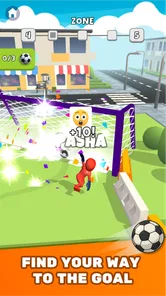
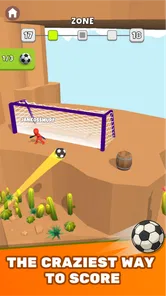
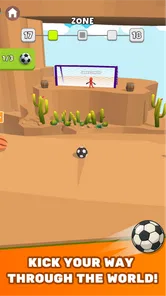
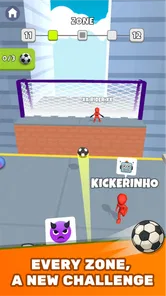
Crazy Kick! Fun Football is a casual arcade game built around short, one-touch football challenges rather than full matches or team management. You guide a ball through each level, aiming for the goal while avoiding defenders and other obstacles. The controls are simple to pick up, but timing and direction matter as stages introduce trickier routes and hazards. It is suited to quick sessions, though its playful physics make the action less like a realistic football simulation.
The game is generally offered as a free download, so you can try its core levels without paying upfront. However, availability, pricing, and included features can vary by platform and region, so check the current Google Play or App Store listing before installing. Like many free mobile games, it may include advertisements and optional in-app purchases. Review the listing and your device’s purchase settings if you want to understand potential costs before you start.
Some parts of Crazy Kick! Fun Football may work without an internet connection, which can make it handy for short sessions while travelling. However, features such as ads, updates, store content, or other connected services may require internet access, and offline availability can differ between app versions. For the most reliable answer, try launching the game after disconnecting from Wi-Fi and mobile data, and check its store listing for any current connectivity requirements.
The game’s straightforward controls and cartoon-style football action can make it accessible to younger players, but parents should still review the current store listing and in-game content. In particular, check whether the version available in your region contains advertisements, optional purchases, or links to external content. You can also use device-level parental controls to restrict purchases and manage screen time. The game is an arcade experience, not a realistic football training or coaching tool.
Expect compact levels focused on steering or kicking the ball through obstacles and into the goal, with new layouts and hazards providing variety as you progress. The controls are designed to be easy to understand, so there is little setup before playing; the challenge comes from choosing the right direction and timing your moves. Its exaggerated physics favor playful, sometimes unpredictable action over precise simulation, making it a better fit for casual play than serious football practice.
On Android, Crazy Kick! Fun Football game asks for these permissions.
Crazy Kick! Fun Football game is also available in 2 other languages on our site.
4.5 out of 5
251,525 reviews
Arcade · VOODOO

Arcade4.6 out of 5

Arcade4.5 out of 5

Arcade4.2 out of 5

Arcade4.4 out of 5

Arcade4.7 out of 5

Arcade4.3 out of 5

Casual3.2 out of 5

Action4.2 out of 5

Arcade4.3 out of 5

Arcade4.1 out of 5
Arcade4.5 out of 5
Arcade4.4 out of 5

Arcade4.6 out of 5

Arcade4.2 out of 5

Arcade4.5 out of 5

Arcade4.7 out of 5

Arcade4.5 out of 5

Arcade4.4 out of 5

Arcade4.4 out of 5

Arcade4.2 out of 5

Arcade4.7 out of 5

Arcade4.8 out of 5



Gamesive reviews games on its own and is not paid by developers for scores. We do not host game files: the download buttons open the official Google Play and App Store pages. Names, icons and screenshots belong to their owners.