
PK XD: Fun, friends & games
Adventure4.7 out of 5

For Android & iOS · tinyBuild
 Analysis by Gamesive
I find Hello Neighbor most interesting when it makes me feel clever and uneasy at the same time. This is an adventure game built around sneaking through a neighbor’s house, noticing how its spaces fit together, and working out how to reach places that seem off-limits. Its horror is more mischievous than relentlessly frightening, but the tension comes from being caught while you are still trying to understand what to do. That mix gives it a distinctive appeal—and also means it will not suit everyone who wants a straightforward, fast-moving adventure.
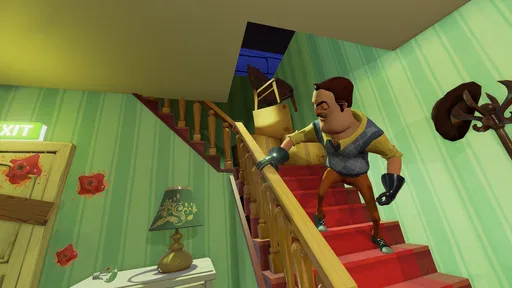
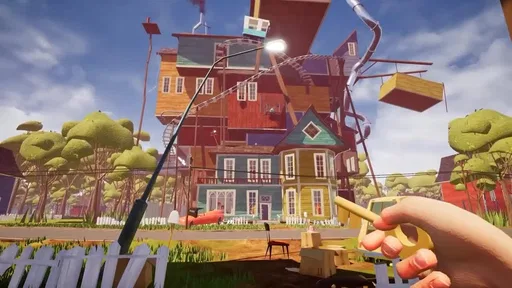
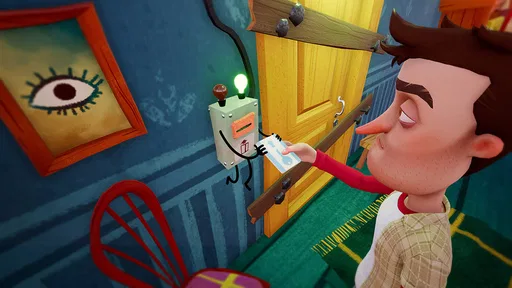
The central pleasure is exploring a house that feels less like a backdrop and more like a problem to study. I found myself paying attention to doors, obstacles, routes, and objects rather than simply moving from one obvious objective to the next. When a path fails, the useful response is often to look again: perhaps there is another way in, or a detail in the room that changes how I should approach it. The game’s puzzles and stealth feed into each other, so solving a problem can involve both figuring out what is possible and finding a moment to try it.
That creates a different rhythm from many adventure games. Instead of following a steady chain of encounters, I would spend time testing the layout, making a plan, and then improvising when it went wrong. The house is most compelling when curiosity takes over: I wanted to know what was behind a blocked route, and each new attempt gave me more to think about. Careful observation matters more here than rushing from one objective to another.
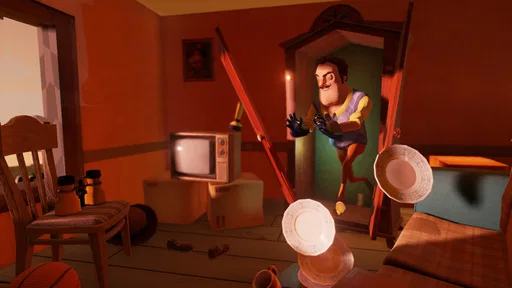
The fear is tied to vulnerability and uncertainty rather than a constant stream of shocks. I could feel cautious even during a quiet stretch, because I was never entirely sure whether an experiment would give me the time I needed. That suspense can be satisfying for players who like being watched and pursued, but it may be uncomfortable for someone who wants a relaxed puzzle game. The tone has a strange, playful edge, yet the pressure of sneaking is still the main flavor.
tinyBuild developed the game, and its premise gives the studio room to make the ordinary act of exploring feel suspicious. A hallway is not just a hallway if it might expose a route, hide a clue, or lead me into trouble. I especially liked the way this encourages me to build a mental map instead of treating each room as an isolated puzzle. Remembering where I have been can make a later attempt feel more deliberate, even when the immediate plan falls apart.
Some games make a failed attempt feel like wasted time. Here, a mistake can still teach me something about the space or about the risks of a route. I learned to treat a failed approach as a small investigation: what did I overlook, and what should I change next time? This is a useful mindset because the game’s appeal depends less on instantly knowing the answer than on gradually becoming more observant.
One practical approach is to avoid changing everything at once. If I try a new route, a different timing, and a new puzzle idea in the same attempt, it is hard to tell what helped. Focusing on one adjustment makes the next try more informative. That small habit turns the stealth-and-puzzle loop into a process of learning rather than blind repetition, and it is one of the best ways to keep the game from feeling arbitrary.
Another helpful habit is to explore with a purpose. When I enter a space, I try to notice not only the immediate obstacle but also where it connects to areas I already recognize. That gives me a better chance of remembering a useful route after being interrupted. It also suits short play sessions: if I pause after learning something specific about the house, returning later is easier than stopping in the middle of a vague, unfinished search.
The same uncertainty that makes the game memorable can also slow it down. When I do not understand what a puzzle expects, repeated attempts can feel more like guessing than deduction. Getting interrupted during exploration can add to that frustration, especially if I was finally making progress. Players who prefer clear objectives, smooth forward momentum, or puzzles with a more explicit chain of clues may find the experience less satisfying.
It is also not the best choice if you want horror that is either deeply serious or purely atmospheric. The game’s odd, playful premise sits alongside the stress of sneaking, and that contrast is part of its identity. I think it works best when I accept that the mood can be strange rather than expecting a conventional haunted-house story. If that combination sounds irritating rather than intriguing, a more linear adventure or a quieter puzzle game is probably a better fit.
There is a trade-off between persistence and patience. Pushing through a confusing section can bring the satisfaction of finally understanding the space, but there is no reason to keep repeating the same failed approach if it is no longer enjoyable. I would take a short break, return with a fresh plan, or replay the last stretch more carefully. The game rewards curiosity, but that does not mean every player will enjoy every stretch of uncertainty.
For a mobile game, the experience asks for attention. I would not choose it as background entertainment while distracted or trying to fill a minute between tasks. A more realistic use case is settling in for a focused session, exploring one area, and stopping once I have learned something useful. That makes it easier to enjoy the atmosphere and remember the layout, rather than feeling that I have spent a short break wandering without a clear result.
I would recommend it to players who like stealth, environmental puzzles, and the feeling of piecing together a place through exploration. It is especially suited to someone who enjoys making a plan but does not mind adapting when that plan fails. If you like games where small discoveries can change how you approach a familiar room, the house offers a more personal kind of challenge than a sequence of self-contained riddles.
It is a weaker match for players who dislike being pursued, become impatient with trial and error, or want a carefully signposted story to carry them forward. Younger players may also want to consider the tone and tension: it is rated Everyone 10+, but the sneaking and horror framing can still feel unsettling depending on a player’s comfort level. I would choose it for a curious player who enjoys mild suspense, rather than someone looking for a completely calm family puzzle.
Compared with typical adventure games that guide players through clear stages, this one puts more weight on learning a single, unsettling environment. Compared with pure puzzle games, it adds the pressure of being discovered. That hybrid is its strongest distinction, but it is also why there is no universal recommendation: someone who wants either clean logic puzzles or uninterrupted action may prefer a game that commits more fully to one of those styles.
The game is free to download, with in-app purchases ranging from $0.99 to $14.99 per item. I would treat the free entry point as a chance to see whether its particular blend of stealth and puzzle-solving clicks with me, rather than assuming that its style will suit every adventure fan. The practical question is less whether the premise sounds appealing and more whether I enjoy cautious exploration when progress is not always immediate.
It has been available since July 25, 2018, and the current version is 2.3.16. It requires Android 8.0 or later. Those details make it easier to judge basic compatibility, while the game’s real suitability depends on your patience for tense exploration. I would also keep in mind that its audience is broad: it has passed 50 million installs, with an average rating of 3.9 from around 551,000 ratings. That suggests plenty of players have tried it, but the more mixed reception fits a game whose unusual rhythm is likely to divide tastes.
For anyone wondering whether it is better approached in long sessions or quick bursts, I lean toward shorter, focused visits with a clear intention. Go in wanting to study a route or make progress on a particular puzzle, not expecting a neat reward every few minutes. That approach makes failed attempts easier to learn from and reduces the chance that the pursuit becomes the whole experience. If you like the house’s odd atmosphere, those pauses can make the next visit more engaging.
My verdict is that Hello Neighbor is a memorable adventure when its central tension works for you: curiosity pulls you forward, while the risk of being caught makes every experiment feel consequential. I would recommend it to patient players who enjoy stealth and environmental problem-solving, and suggest skipping it if you need constant guidance or dislike trial and error. It is not a frictionless puzzle game, but its unusual combination of exploration and suspense gives it a character that is hard to confuse with a standard, linear adventure.
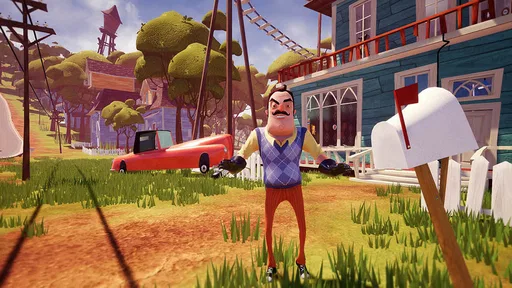
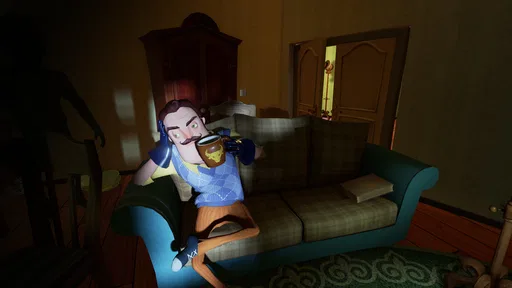
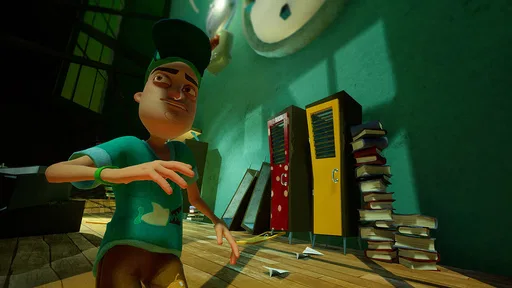
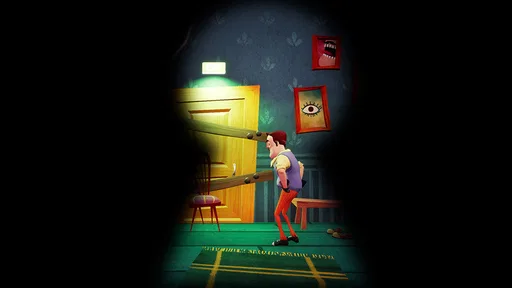
Hello Neighbor is a stealth horror game in which you try to uncover the secrets hidden in the basement of a suspicious neighbor’s house. You explore the property, solve environmental puzzles, and look for ways past obstacles while avoiding being caught. Its mix of cartoon-style visuals, suspense, and trial-and-error exploration makes it feel different from a traditional action-focused horror game.
The neighbor reacts to your actions and may adapt to strategies you use repeatedly, so the same route or trick may not remain reliable throughout a session. This can make exploration tense, but it can also lead to unpredictable encounters and occasional frustration. If you are caught, you may need to rethink your approach, use the house’s layout differently, or search for another solution.
Hello Neighbor uses colorful, stylized graphics rather than realistic gore, but it is still built around being chased, hiding, and uncovering unsettling secrets. Whether it is suitable depends on a child’s sensitivity to suspense and frightening situations, as well as the age guidance shown for the specific store listing in your region. Parents should review that rating and consider watching gameplay before allowing younger children to play.
The main experience is a single-player game, so its core exploration and puzzle-solving do not depend on online opponents. However, requirements can vary by platform and version, and an internet connection may be needed to download the game, complete installation, verify a purchase, or receive updates. Check the current Android or iOS store listing and the game’s in-app notices to confirm what applies to your device.
Availability and pricing can differ between Android and iOS, and may also change by country or over time. A store listing may offer a paid download, a free installation with optional purchases, or another pricing arrangement, so do not assume that the game is free just because it appears in search results. Before downloading, check the official listing for the current price, in-app purchase details, age rating, and device requirements.
On Android, Hello Neighbor asks for these permissions.
Hello Neighbor is also available in 2 other languages on our site.
3.9 out of 5
550,575 reviews
Adventure · tinyBuild

Adventure4.2 out of 5

Adventure3.5 out of 5

Adventure4.3 out of 5
Adventure4.1 out of 5

Adventure4.3 out of 5

Adventure3.3 out of 5
Adventure4.7 out of 5

Adventure4.5 out of 5

Adventure4.5 out of 5

Adventure4.4 out of 5
Adventure4.4 out of 5

Adventure4.6 out of 5

Adventure4.4 out of 5

Adventure4.2 out of 5

Adventure3.6 out of 5

Adventure4.2 out of 5

Adventure3.7 out of 5

Adventure4.0 out of 5



Gamesive reviews games on its own and is not paid by developers for scores. We do not host game files: the download buttons open the official Google Play and App Store pages. Names, icons and screenshots belong to their owners.