Block Blast! Finds Its Place in the New Rhythm of Phone Use
 Analysis by Gamesive ·
Phone operating systems keep making the screen busier: notifications arrive in more places, privacy prompts interrupt more flows, and battery tools are quicker to put background activity on a leash. Against that churn, Block Blast! makes a quiet case for the simplest kind of mobile game: one that asks for attention only while you are playing. The latest Android and iOS shifts do not reinvent its wooden-looking grid or its familiar block-dragging loop. They change the conditions around it, and that makes the game’s brisk, self-contained design feel less like a limitation than a deliberate fit.
That distinction matters. There is no sprawling world to load, no opponent waiting on a server, and no complicated session to resume after a call. You place shapes, clear lines, and try not to run out of room. The pleasure is immediate; the strategy builds one move at a time. On a phone increasingly organized around alerts, permissions, and background tasks, Block Blast! is at its best when it stays in the foreground and lets the rest of the device fade away.
What an OS update changes around the puzzle
Neither Android nor iOS has introduced a new rule for block puzzles. The meaningful changes are more practical: users have finer control over notifications and privacy, devices manage background work more aggressively, and interface conventions continue to favor clear, focused apps. Those shifts affect how a casual game is discovered, opened, interrupted, and returned to. They do not give Block Blast! a new mechanic, but they raise the value of a game that can start quickly and survive a short session ending without ceremony.
That is a good match for the game’s basic architecture. A round does not depend on a live event or a synchronized team. If an operating system pauses the app while you switch to a message, the interruption does not threaten a multiplayer match. If you silence alerts, the core puzzle remains intact. The game’s reward comes from reading the board and making a satisfying placement, not from maintaining a constant connection to a service.
There is a trade-off, though. A low-friction game can become an easy reflex: open it for a minute, then discover that several rounds have passed. More OS control can help players limit interruptions, but it cannot supply a stopping point the design does not emphasize. The game’s ease of entry is both its strength and the reason a player may need to set their own boundary.
What players notice first
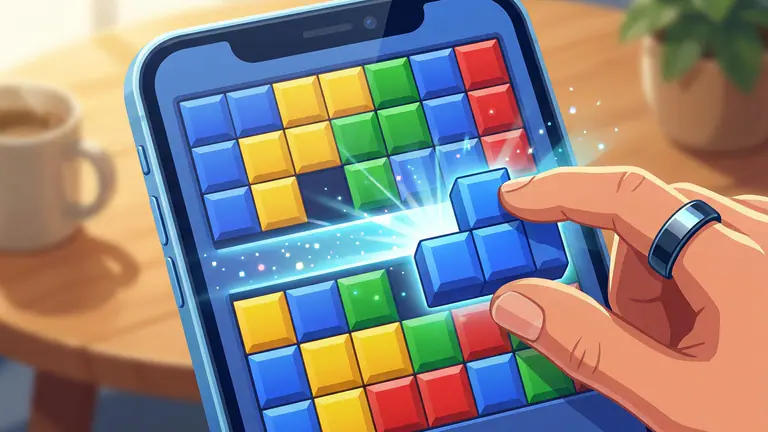
The first impression is still tactile rather than technical. A grid waits, a small selection of block shapes sits below it, and a finger drags a piece into position. Completed horizontal or vertical lines vanish, clearing space and producing that crisp little rush of progress. There is no long tutorial to wade through before the central idea makes sense. The game shows its vocabulary through play, then leaves the player to improve their judgment.
What becomes apparent after a few turns is that space is the real resource. The pieces are not rotated into whatever shape would be convenient, so each placement has consequences. A tempting fit can divide the board into awkward pockets; a less obvious move may keep several future options open. Clearing multiple lines at once feels excellent, but preserving room for the next set of shapes is often the smarter victory.
On current phones, that clarity survives the small interruptions of everyday use. You can look away, check an alert, and return to a board whose problem is easy to understand at a glance. This is not the same as claiming that every version behaves identically across devices. Screen size, touch response, and the exact handling of saved progress can vary. The point is that the puzzle itself does not ask the operating system for much.
A day-to-day game built for fragments
That light footprint changes the rhythm of play. A round can occupy the wait for coffee, the pause between errands, or a few quiet minutes before sleep. There is no narrative thread to lose if the session ends suddenly. The board is the whole conversation: scan the open spaces, compare the available shapes, place one, and reassess.
Its replay value comes from pressure rather than plot. Each new arrangement makes familiar shapes feel different, and a score gives the player a simple reason to try again. The loop is easy to repeat but not entirely mindless; as the board tightens, every choice becomes more consequential. I like that tension most when a run is going well enough to make me cautious. A board with plenty of space invites bold clearing; a crowded one turns even a small placement into a decision.
The downside is that the game can feel thin if you want a destination beyond a better run. There is no rich cast or campaign to attach meaning to a session, and the same visual language can become repetitive over a long stretch. Its routine is the appeal, but routine can also be the ceiling. Anyone looking for a puzzle with a steady stream of new systems may tire of repeating the same fundamental challenge.
Where the newer phone ecosystem helps
Modern mobile platforms are better at letting people decide what gets their attention. Notification controls, focus settings, and more visible privacy choices make it easier to shape a phone around a brief game rather than let every app demand equal access. For Block Blast!, that is a useful environment precisely because the game does not need to interrupt the user to make its case. You can open it when you want a puzzle and leave it alone when you do not.
There is also a practical advantage in how modest the game’s demands are. It does not rely on elaborate visual effects or a constantly active social layer to make a board readable. That suits a broad range of devices and everyday conditions, from a quick session on a small screen to a longer stretch on a larger one. Yet the polish is not a substitute for a deeper ecosystem. The game’s strongest relationship is with the player’s attention, not with the operating system’s more advanced features.
Compatibility friction still deserves a candid mention. OS updates can alter permission prompts, notification behavior, or how an app is paused and resumed, while different devices vary in their touch feel and display dimensions. Players should not assume that an update will add new puzzle content or make progress handling identical everywhere. If a long run matters, check the game’s current save and account options on your own device rather than relying on a vague expectation that every session will transfer perfectly.
There is another friction point: the game’s broad accessibility can make it difficult to tell where the puzzle ends and any surrounding promotional or monetization elements begin. The cleanest experience is the board itself. When prompts or extras pull focus from it, they feel more intrusive than they would in a game built around a larger progression system. A focused design creates a high bar for anything placed beside the puzzle.
What rivals reveal about the format
The contrast with other mobile games is useful because it shows what Block Blast! chooses not to be. Last Asylum: Plague and Tank Busters: Cannon Battle lean on more involved settings and action-oriented progression; Magic Tiles 3 makes timing and musical input central; Block Craft 3D turns play toward building. Those games ask players to engage with a more defined theme or activity. Block Blast! strips the premise down to shapes, space, and judgment.
That simplicity is not a failure to keep pace with mobile gaming. It is a different adaptation to the phone. A game such as Magic Tiles 3 depends on a more deliberate rhythm of input, while Block Blast! can be played in an uneven pocket of time and paused as soon as life intrudes. Block Craft 3D offers a more expressive kind of creation; Block Blast! delivers the smaller satisfaction of making a cramped board work. Each approach suits a different mood, but the latter asks less of the device and the player’s schedule.
The rivals also underline a broader lesson for developers responding to OS changes. Adding features does not automatically make a mobile game feel more modern. A reliable, readable core can fit better with a phone’s evolving privacy and notification controls than an experience that depends on constant prompts or uninterrupted play. Block Blast! benefits from being able to keep its promise in a few seconds.
The direction of mobile play
Phones increasingly serve as both entertainment devices and interruption machines. Operating systems try to give users more say over that balance, but app design still determines whether a game respects a short visit. Block Blast! suggests that mobile polish can mean removing demands: make the goal obvious, keep the round self-contained, and let a player return without a lengthy re-entry process.
This is a modest claim, not a prediction that every game should become a grid puzzle. Longer experiences have their place, and some players want worlds, stories, or social competition. But the small-session model is likely to remain relevant as phones become more tightly managed and people reserve attention in shorter blocks. The best version of that model does not confuse ease of access with an obligation to keep playing.
For the right player, the appeal is specific: a quick-thinking puzzle that rewards spatial planning without demanding a large time commitment. Casual players can enjoy the immediate matching of shape to space; score chasers can work on keeping a crowded board alive for longer. Anyone who needs a story, a campaign, or regular novelty should look elsewhere. The strongest audience is the person who likes a clean problem and is content for the problem itself to be the point.
My verdict is that the OS-update story here is not a dramatic feature rollout. It is a fit between a lightweight game and a phone culture that increasingly values control over attention. Block Blast! remains compelling because its hook, loop, and replay value survive interruptions without needing the operating system to do anything clever. Watch future updates for clearer progress handling, useful refinements, and restraint around extras. The board is already the best part; the smartest next step is to protect the fast, focused pleasure that makes it worth opening.
Games like Block Blast!
View all: Games like Block Blast!
Tile Explorer - Triple Match
Puzzle4.9 out of 5

Arrows – Puzzle Escape
Puzzle4.7 out of 5

Royal Kingdom
Puzzle4.8 out of 5

Arrow Puzzle: Tap Puzzle Games
Puzzle4.8 out of 5

Amaze GO!
Puzzle4.9 out of 5

Ball Sort Puzzle - Color Game
Puzzle4.9 out of 5
More articles on the blog
View all: More articles on the blog
In Little Kitty, Big City, Curiosity Is the Best Way Home

Whiteout Survival Shows What Mobile Strategy Now Demands
