
Tiles Hop Music & Ball Game
For Android & iOS · AMANOTES PTE. LTD.
- 4.3 out of 5Rating
- 3.37MReviews
- 500.00M+Downloads
- MusicGenre
Game details
- Version
- 8.18.1
- Updated
- Requires
- 7.0
- Price
- Free
- Age rating
- Everyone 10+
- In-app purchases
- $0.99 - $49.99 per item
Screenshots



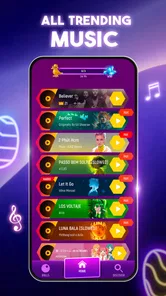


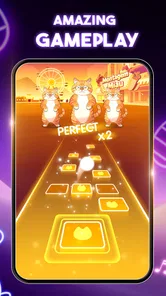
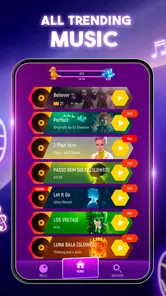
Tiles Hop Music & Ball Game review
 Analysis by Gamesive
Tiles Hop Music & Ball Game puts a simple idea at the center of its play: guide a bouncing ball along a path of tiles while keeping pace with the music. It is easy to understand at a glance, but the appeal comes from turning that straightforward action into a rhythmic challenge. I find it best suited to quick sessions, when I want something lively that asks for attention without making me learn a complicated set of rules.
A rhythm game built around small goals
The first goal is clear: stay on the tiles and follow the beat. That immediate objective gives each attempt a satisfying focus. I can concentrate on the next landing rather than wading through a long tutorial or a complex control scheme. The store describes the experience as a song game and a challenge inspired by piano and magic tiles, and the central pleasure is exactly that mix of music and timing.
In practice, the ball’s movement makes the rhythm feel physical. A song is not just background sound; it becomes a cue for where I should direct my attention. I watch the path, listen for the beat, and try to make each move at the right moment. When I settle into that pattern, even a brief run can feel engaging. When I lose the rhythm, the mistake is usually easy to understand: my timing or direction was off.
That clarity is important for a mobile game. The best early goal is simply to improve one run at a time, whether that means reacting more confidently, keeping my focus for longer, or getting more comfortable with the musical pacing. The game’s premise does not need a long explanation to make sense, which helps it work well for casual play and for players who want to jump straight into an activity.
Why the opening is easy to approach
The basic challenge is accessible even if you do not think of yourself as a rhythm-game expert. The idea of hopping to a beat is familiar, and the visual path gives the player something concrete to follow. I appreciate that the goal is apparent from the outset: stay in motion, read the tiles, and try to keep the ball on course. That makes it easy to pick up for a few minutes without needing to plan a long session.
At the same time, a simple objective does not mean that every attempt feels automatic. Music can make the action more absorbing, but it also demands attention. The player is balancing what they see with what they hear, and that combination gives the game its main source of challenge. It is a modest but effective loop: understand the task, attempt it, notice where the rhythm slipped, and try again with a little more focus.
As a music game for quick mobile sessions, it has a clear identity. I would not approach it as a deep simulation or a story-led adventure. Its appeal is in the immediate feedback of playing along with a song and trying to keep control. That makes it easy to recommend to anyone who enjoys timing-based games, though people looking for a slower or more exploratory experience may find the repeated focus on rhythm less compelling.
Progress you can feel through play
Progress in a game like this is most satisfying when it comes from getting better at the basic action. Each attempt gives me a chance to read the rhythm more naturally and react with less hesitation. That sense of personal improvement can be rewarding even when the goal is small. I do not need a complicated progression chart to understand whether I am becoming more confident; the difference is apparent in how steadily I follow the beat.
The game’s broad popularity also suggests that this direct format has found a large audience. It has more than 500 million installs, and its average rating is 4.3 from around 3.4 million ratings. Those figures do not tell me whether every player will enjoy the same things, but they do underline how widely the music-and-tiles concept has reached. For a new player, the important point is that the core idea is familiar and immediately readable.
There is a useful distinction between progress that comes from practice and progress that comes from unlocking content. The strongest part of the experience, from my perspective, is the practice loop: each run gives the player a direct reason to focus and improve. Unlocks can make continued play feel more rewarding in many games, but I would not judge this one solely by how much it offers beyond that central rhythm challenge. Its foundation is the moment-to-moment act of hopping to the music.
That foundation also keeps the experience easy to revisit. I can return with a simple intention—to play more accurately or stay focused—and get straight into the activity. There is no need to remember a complicated plot or a sequence of intricate objectives. This kind of uncomplicated return value is a real strength for a casual game, especially when I want a quick diversion rather than a long commitment.
How the challenge finds its pace
The difficulty comes from coordinating movement and timing, not from learning a large number of rules. That makes the challenge feel approachable at first, while still leaving room for mistakes. The moment I become distracted or anticipate the beat incorrectly, the run can lose its smoothness. I like that the basic task remains easy to describe even when executing it well takes attention.
Its pacing is closely tied to the music. A song gives the action a natural pulse, and the tile path gives that pulse a visual form. When those elements line up for me, the game feels fluid and satisfying. When they do not, I have to make a conscious effort to catch up and judge the next move. That contrast is where much of the tension comes from, and it is also why a short attempt can feel more engaging than its simple controls might suggest.
I would describe the challenge as focused rather than broad. It asks me to improve one central skill—keeping the ball on course in time with the music—rather than juggling several unrelated systems. That focus helps the game stay readable, though it can also make the experience feel repetitive if the rhythm-based loop is not what I am in the mood for. Players who enjoy mastering a clear mechanic are more likely to appreciate the gradual push to perform better.
The store summary highlights piano tiles and magic tiles as part of the game’s musical appeal. That framing fits the easy-to-grasp fantasy of playing along with music through visual targets. Still, the main thing I notice as a player is not a complicated musical toolkit; it is the need to keep watching, listening, and responding. The experience works because those pieces reinforce one another rather than competing for attention.
Replay value and the pressure to continue
A game built around repeated attempts can naturally encourage one more try. That can be a positive when I am enjoying the rhythm and want to improve, but it can become tiring if I keep chasing a better run after the fun has faded. For me, the healthiest way to play is to treat each attempt as a short challenge, not as an obligation to keep going. The straightforward structure makes it easy to stop and return later.
There is also a commercial side to consider. The game is free to download and includes in-app purchases ranging from $0.99 to $49.99 per item. That makes it sensible to keep an eye on spending, particularly if a device is shared or used by younger players. The game carries an Everyone 10+ content rating, but a rating does not replace practical care around purchases. I would make sure anyone playing understands that optional spending can be part of the experience.
The purchase range does not change the central appeal of the game: timing a bouncing ball to music. I would focus first on whether that basic loop is enjoyable before considering any optional purchases. For players who like the core challenge, the free entry point makes it easy to see whether the rhythm-based play suits them. For those who do not connect with the repeated timing task, spending is unlikely to solve that mismatch.
Its long-running presence is another sign of its staying power. Tiles Hop was released on January 16, 2018, and the current version is 8.18.1. It is developed by AMANOTES PTE. LTD. and is available for devices running Android 7.0 or later. These details matter if someone is checking basic compatibility, but they do not change my main assessment: the game’s success depends on whether its simple musical challenge feels satisfying to repeat.
A progression loop that favors skill
When I think about goals, unlocks, challenge, and pacing together, the most convincing part is the way the core action gives every session an immediate purpose. The player does not need a lengthy explanation to know what to try next. Keep the rhythm, guide the ball, and do a little better. That is an effective structure for a casual game, because it makes starting easy and leaves improvement open-ended.
The progression verdict is therefore strongest for players who enjoy skill-based repetition. If I like the feeling of refining my timing, the game gives me a clear reason to return. If I need a story, a large variety of activities, or a deep progression system to stay interested, the central loop may not provide enough variety on its own. I see that as a matter of taste rather than a flaw in the basic concept: the game knows what it wants to be and keeps its attention on music and movement.
For anyone searching for a free music game on mobile with simple controls and a clear rhythmic objective, this is an easy one to understand and try. The combination of a bouncing ball, tile path, and beat creates a compact challenge that can fit into spare moments. I would recommend it most to players who enjoy quick retries and the satisfaction of reacting more confidently each time.
Overall, Tiles Hop earns its appeal through an accessible premise and a focused rhythm challenge. Its goals are easy to grasp, its difficulty asks for attention without demanding a complicated rulebook, and its pacing suits short sessions. The in-app purchase range is worth keeping in mind, but the central experience is simple to evaluate: if hopping to the beat sounds fun, this game offers a direct way to do it. If that loop is not your style, its straightforward design may feel repetitive rather than relaxing.
What we like
- Simple tap controls make the game easy to pick up.
- Short levels work well for quick play sessions.
- Visual effects respond to the beat and add energy.
- A range of tracks offers variety between runs.
- Timing challenges can help build rhythm and focus.
What could be better
- Precise timing can take practice on faster songs.
- Some tracks or features may require in-app purchases.
- Ads may interrupt play between attempts.
- Gameplay can feel repetitive after extended sessions.
- Performance may vary across older devices.
Frequently Asked Questions
What is Tiles Hop Music & Ball Game?
Tiles Hop Music & Ball Game is a rhythm-based arcade game in which you guide a bouncing ball across a path of floating tiles while music plays. The aim is to keep the ball on the tiles and follow the beat for as long as possible. Its simple controls make it easy to try, while changing tracks and patterns provide a test of timing and concentration.
How do you play Tiles Hop Music & Ball Game?
You typically press and hold the screen, then move your finger left or right to steer the ball between tiles. The ball bounces automatically, so success depends on anticipating the next tile and matching your movements to the song’s rhythm. Missing the path ends the run. The controls are straightforward, but faster sections can require quick reactions and a little practice.
Can I play Tiles Hop Music & Ball Game offline?
Some versions or portions of the game may allow you to replay downloaded or already available tracks without an internet connection, but access to songs, new content, leaderboards, advertisements, and other online features can depend on being connected. Offline availability may also vary by app version and device. Check the current store listing and test the game on your device if offline play is important to you.
Is Tiles Hop Music & Ball Game free to download and play?
The game is generally offered as a free download, but free access does not necessarily mean every feature or song is available without limits. Depending on the current version, you may encounter advertisements, optional in-app purchases, or other prompts while playing. Store policies and the game’s monetization can change, so review the Google Play or App Store listing before downloading, especially if you plan to make purchases.
What should I check before downloading Tiles Hop Music & Ball Game?
Check that your phone or tablet meets the app’s current operating-system and storage requirements, and read the latest store listing for details about permissions, ads, in-app purchases, and available features. The game relies on music and quick visual timing, so sound settings and screen responsiveness can affect your experience. Reviews can also help identify device-specific performance issues or changes introduced in recent updates.
Permissions
On Android, Tiles Hop Music & Ball Game asks for these permissions.
- Photos/Media/Files
- read the contents of your USB storage
- Storage
- read the contents of your USB storage
- Wi-Fi connection information
- view Wi-Fi connections
- Other
- view network connections, change network connectivity, full network access, control vibration, prevent device from sleeping, Google Play license check, read Google service configuration
Languages
Tiles Hop Music & Ball Game is also available in 2 other languages on our site.
User reviews
4.3 out of 5
3,367,786 reviews
- 71%
- 11%
- 6%
- 3%
- 9%
Download Tiles Hop Music & Ball Game
Music · AMANOTES PTE. LTD. · Free
Games like Tiles Hop Music & Ball Game
View all: Games like Tiles Hop Music & Ball Game
Magic Tiles 3™ - Piano Game
Music4.6 out of 5
Music Piano 7: Rush Song Games
Music4.8 out of 5

Magic Dancing Tiles
Music4.8 out of 5

Kpop Piano Beats - Music Game
Music4.7 out of 5
More from AMANOTES PTE. LTD.
View all: More from AMANOTES PTE. LTD.Magic Tiles 3™ - Piano Game
Music4.6 out of 5
About this listing
- Game
- Tiles Hop Music & Ball Game
- Developer
- AMANOTES PTE. LTD.
- Package
- com.amanotes.beathopper
- Version reviewed
- 8.18.1
Gamesive reviews games on its own and is not paid by developers for scores. We do not host game files: the download buttons open the official Google Play and App Store pages. Names, icons and screenshots belong to their owners.