Street Racing 3D
Racing4.5 out of 5
For Android & iOS · Fingersoft
 Analysis by Gamesive
I would recommend Hill Climb Racing 2 to someone who wants a racing game that is easy to start but takes a little care to master. Its appeal is not about memorizing a complicated track or steering through traffic. You manage a vehicle over uneven ground, balancing speed with the need to keep it upright. A run can feel smooth one moment and turn into a tumble after a poorly judged landing the next. That simple tension gives each attempt a clear purpose: get a little farther, handle the next obstacle better, and learn from the last mistake.
It is a free racing game from Fingersoft, and it has found a substantial audience: the app has more than 100 million installs and a 4.5 average from around 4.7 million ratings. Those figures suggest broad appeal, but they do not tell you whether its particular rhythm will suit you. In my experience, the key question is whether you enjoy short bursts of driving where throttle and balance matter as much as forward speed.
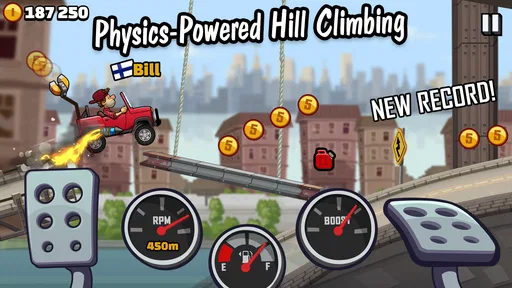
The first thing I would set aside is the idea that this plays like a conventional circuit racer. Hill Climb Racing 2 is built around bumpy terrain and precarious rises, so success depends on how you control the vehicle over the landscape. Accelerating hard may help you climb, but carrying too much speed over a crest can make the landing awkward. The fun is in making small corrections rather than holding the accelerator and hoping for the best.
That makes the game approachable without making it mindless. The basic objective is easy to grasp, and a new player can begin learning by feel. But even a simple slope creates a decision: push for momentum, ease off to keep the vehicle settled, or accept a slower climb to avoid losing control. I like that the challenge comes from reading the ground and adjusting, rather than from a long list of controls to memorize.
The online racing focus gives those driving decisions a competitive context. If you mainly want a solitary, realistic motorsport simulation, this is not the same kind of experience. It leans toward playful, physics-driven races in which awkward recoveries and imperfect runs are part of the appeal. For a quick mobile session, that lighter approach is easier to pick up than a game built around detailed track practice and precision steering.
The game is listed as Everyone, which makes its general tone accessible for a broad audience. That age classification does not mean every player will enjoy the same things, of course: younger players may like the immediate action, while adults who want a serious racing model may find the physics more comic than authentic. I would choose it for quick competitive driving, not as a substitute for a simulation racer.
When you first open Hill Climb Racing 2, I would keep your goal modest: get comfortable with how the vehicle reacts before worrying about perfect runs. The easiest mistake is to treat every stretch as a chance to accelerate as much as possible. On rough ground, speed is useful only if you can control what happens after a bump or crest. Try easing off before the vehicle becomes unstable, then build speed again once it settles.
That approach also makes the opening sessions less frustrating. If a run ends in a spill, think about the moment just before it: did you enter a rise too fast, keep pushing while the vehicle tipped, or try to recover too late? Changing one thing on the next attempt is more useful than repeating the same full-throttle approach. The game rewards that kind of quick, practical learning.
My first meaningful success would not be a flawless performance. It would be completing a run with a better sense of when to accelerate and when to let the vehicle settle. Once you can cross uneven ground without reacting wildly to every bump, the driving starts to feel intentional. That is a satisfying early milestone because it comes from your own control, not merely from tapping through the opening.
For an everyday example, imagine you have a few minutes while waiting for a friend or riding out a short break. You can start a quick session, focus on one troublesome section, and stop once you have made a cleaner attempt. It works well in that setting because each try gives immediate feedback. It is less suited to someone looking for a long, uninterrupted racing campaign or a calm game that demands little attention: even a short run asks you to watch the terrain.
A useful technique is to treat a crest and its landing as one sequence. Instead of accelerating until the front lifts and then making a sudden correction, ease off as the vehicle approaches the top. That gives you a better chance of landing in a controlled position. On a steep section, retaining enough momentum can matter, so the answer is not simply “go slowly”; it is to distinguish a climb that needs power from a rise that needs restraint.
Another practical habit is to focus on the next change in terrain, not just the vehicle’s current speed. If the ground is about to fall away, a small adjustment before the drop is usually easier than trying to correct a bad angle in midair. This is not a secret trick or a guarantee of a perfect run. It is a way to make the physics feel less random and to understand why one attempt went better than another.
When you are learning, avoid changing your driving style and your upgrade choices at the same time. If you alter several things between runs, it becomes harder to tell what helped. A cleaner test is to keep your approach steady and make one adjustment, then see whether the same stretch feels more manageable. That simple routine turns retries into useful practice rather than a string of near-identical crashes.
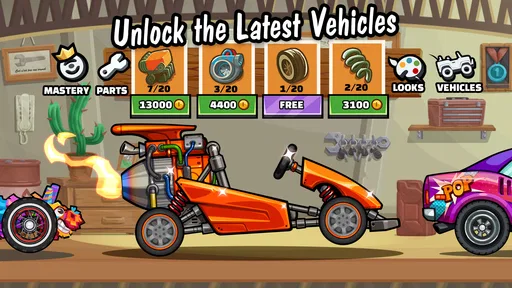
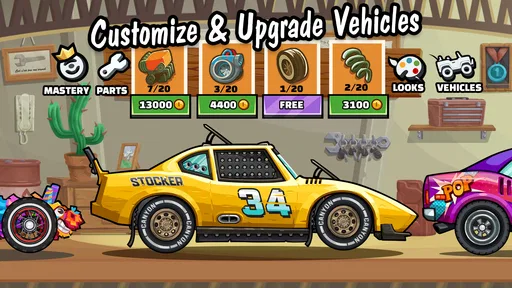
The game includes vehicle upgrades, so there is a progression layer alongside the immediate driving. My advice is to use upgrades to support a style you already understand, rather than expecting them to solve every mistake. If you repeatedly lose control after a crest, better equipment alone will not teach you to ease off at the right moment. Learning the handling remains part of the satisfaction.
There are in-app purchases, with items ranging from nine cents to two hundred dollars. That is a wide range, so I would check any purchase carefully before confirming it, especially if a device is shared with a child. The game itself is free to download, which makes it easy to try before deciding whether you want to spend. I would not treat an optional purchase as a necessary first step; first find out whether the basic driving loop is enjoyable for you.
For players who prefer to keep spending at zero, the sensible approach is to enjoy the game at its own pace and avoid measuring progress against someone who has invested more time or money. If you are uncomfortable with optional purchases appearing in a free game, that is a fair reason to choose a paid racing title with a different business model. The right choice depends on whether you value a free starting point or prefer a more predictable purchase structure.
The most common confusion is assuming that more acceleration always means more progress. In a conventional racer, holding speed through a straight may feel natural; here, the surface itself changes the risk. A vehicle that reaches a rise quickly may leave it at an awkward angle. When that happens, the useful response is to consider the approach and timing, not to assume the game has simply behaved unpredictably.
It can also be tempting to treat every failed run as a need for a stronger vehicle. Upgrades can change how a vehicle performs, but they do not replace reading the course. If you find yourself repeatedly tipping at the same kind of obstacle, first try changing when you accelerate. If you can handle that section more reliably but still struggle to keep up, then progression may be worth exploring. Separating those two problems makes the game easier to understand.
The online racing emphasis may raise another question: is this mainly for playing against other people, or can a newcomer enjoy learning first? I would approach it as a game where you can build confidence through the driving itself before worrying about comparison. Competitive pressure can make each mistake feel more significant, so it helps to focus on consistent control rather than expecting to perform brilliantly immediately.
It is also worth being honest about the game’s limits. The repeated focus on balancing over rough ground may become familiar if you want a constant stream of new driving ideas. Players seeking realistic vehicle handling, elaborate track technique, or the feel of a serious motorsport title will probably be happier with a conventional circuit racer. I would skip this one if its playful, physics-led style sounds more irritating than entertaining.
For a first-time player, the next step after getting comfortable is to build consistency rather than chase a single lucky run. Pick the moments that keep catching you out, make one adjustment, and see whether you can repeat a cleaner approach. That gives you a practical reason to return and makes upgrades feel like part of a plan instead of a shortcut. If online races are what drew you in, improved control will also make those sessions less dependent on frantic reactions.
I think this is a strong fit for people who enjoy learning by trying again, especially anyone who wants racing that works in short sessions. It can also suit families looking for an accessible game to sample together, though I would keep an eye on optional purchases when a child is playing. If you are mainly after an offline, story-led journey, a detailed driving simulator, or a racer with realistic tracks and handling, a different category of game is likely a better match.
Hill Climb Racing 2 has a 4.5 average across roughly 4.7 million ratings, and its staying power is easy to understand: the core challenge is simple to explain, but small changes in timing can make a run feel different. Fingersoft released it on November 27, 2016, and the current version is 1.76.1; it requires Android 7.0 or later. Those details make it straightforward to check compatibility before installing, while the free price means you can try the driving without paying upfront.
My recommendation is to start with patience, not purchases or perfection. Learn how the vehicle behaves on a climb, ease off when a landing looks risky, and treat each failed attempt as a clue about your timing. If that small cycle of adjustment feels rewarding, this racing game can be an enjoyable companion for spare moments. If you want realism or a very different kind of competition, it is better to know that before downloading.
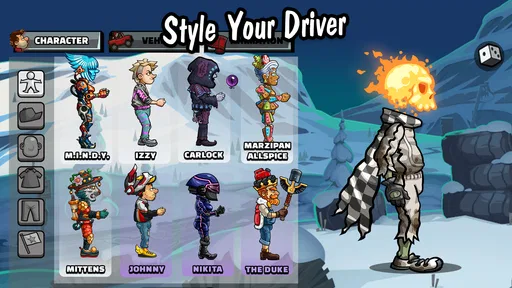
Hill Climb Racing 2 is a physics-based racing game in which you drive over bumpy tracks, steep hills, jumps, and other obstacles. Its appeal comes from balancing acceleration and braking to keep your vehicle upright while collecting coins and reaching the finish. You can unlock and upgrade vehicles, customize your driver, and compete in solo challenges or multiplayer events.
Some parts of Hill Climb Racing 2 can be played without an internet connection, so it may suit short sessions when you are offline. However, online features such as multiplayer competitions, leaderboards, and certain events require a connection. Availability can also depend on the game version and device, so check which modes work after installing before relying on offline play.
Hill Climb Racing 2 is generally available as a free download, and you can play without paying to unlock every basic feature. The game may offer optional in-app purchases, such as currency or other items, and advertisements may appear. Purchases are not necessary for trying the core racing gameplay, but progression and upgrades can take time if you choose not to spend money.
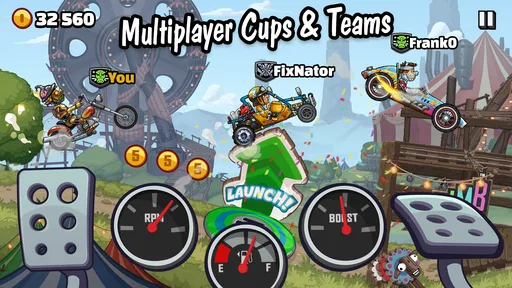
Yes. Hill Climb Racing 2 includes online competitive features where you can race against other players, take part in events, and compare results through rankings. The game also has team-oriented features, though the exact events and options can vary over time. Multiplayer requires an internet connection, and your experience may depend on connection quality, matchmaking, and the current availability of online events.
The game uses cartoon-style vehicles and exaggerated crashes rather than realistic violence, which may make it appealing to younger players. However, age suitability depends on the child and the rating shown in the relevant app store. Hill Climb Racing 2 may include advertisements and optional in-app purchases, so parents should review device settings and consider enabling purchase controls before letting a child play.
On Android, Hill Climb Racing 2 asks for these permissions.
Hill Climb Racing 2 is also available in 2 other languages on our site.
4.5 out of 5
4,719,585 reviews
Racing · Fingersoft
Racing4.3 out of 5

Racing4.6 out of 5

Racing4.3 out of 5
Racing4.5 out of 5

Racing4.6 out of 5
Racing4.5 out of 5
Racing4.3 out of 5
Racing4.5 out of 5
Racing4.5 out of 5

Racing4.6 out of 5
Racing4.6 out of 5

Racing4.3 out of 5

Racing4.4 out of 5
Racing4.5 out of 5

Racing4.2 out of 5
Racing4.6 out of 5
Racing4.6 out of 5

Racing4.4 out of 5
Racing4.6 out of 5



Gamesive reviews games on its own and is not paid by developers for scores. We do not host game files: the download buttons open the official Google Play and App Store pages. Names, icons and screenshots belong to their owners.